
3
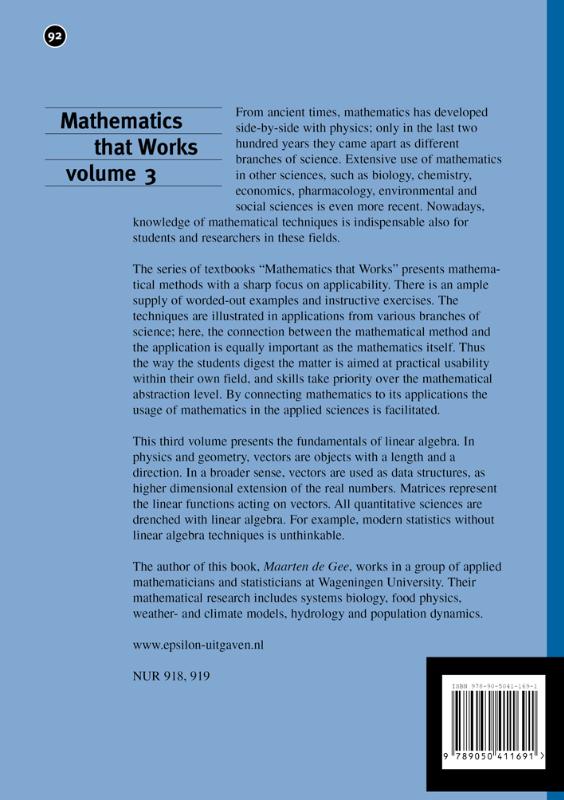
From ancient times, mathematics has developed side-by-side with physics; only in the last two hundred years they came apart as different branches of science. Extensive use of mathematics in other sciences, such as biology, chemistry, economics, pharmacology, environmental and social sciences is even more recent. Nowadays, knowledge of mathematical techniques is indispensable also for students and researchers in these fields.The series of textbooks “Mathematics that Works” presents mathematical methods with a sharp focus on applicability. There is an ample supply of worded-out examples and instructive exercises. The techniques are illustrated in applications from various branches of science; here, the connection between the mathematical method and the application is equally important as the mathematics itself. Thus the way the students digest the matter is aimed at practical usability within their own field, and skills take priority over the mathematical abstraction level. By connecting mathematics to its applications the usage of mathematics in the applied sciences is facilitated.This third volume presents the fundamentals of linear algebra. In physics and geometry, vectors are objects with a length and a direction. In a broader sense, vectors are used as data structures, as higher dimensional extension of the real numbers. Matrices represent the linear functions acting on vectors. All quantitative sciences are drenched with linear algebra. For example, modern statistics without linear algebra techniques is unthinkable.
In het kort
ISBN-13
9789050411691
Uitgever
Verschenen
27 september 2018
Druk
2
Bibliografisch
ISBN-139789050411691
SerieEpsilon uitgaven — deel 92
Editie1
Druk2
TaalEngels eng
Pagina’s438
GeïllustreerdJa
Uitgave
UitgeverEpsilon uitgaven
CB-relatie-id7600250
Verschenen27 september 2018
StatusLeverbaar 04
BeschikbaarheidBeschikbaar 20
Zonder prijsPrijs volgt
Vorm & inhoud
ProductvormPaperback BC
SamenstellingLos product
Classificatie
NUR (hoofd)Wiskunde algemeen 918
NUR (alle)918 Wiskunde algemeen
Medewerkers
Auteur A01Maarten de Gee
Herkomst
Werk-id (NSTC)500142735
MeldingBevestigd bij publicatie 03
Bijgewerkt6 augustus 2026
NSTC 500142735 · CB-relatie 7600250 · Bijgewerkt 6 augustus 2026