
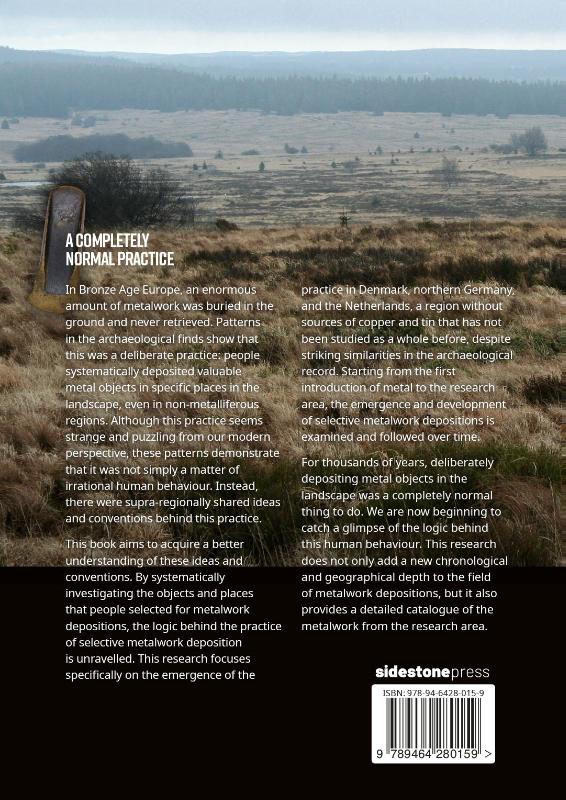
A completely normal practice The emergence of selective metalwork deposition in Denmark, north-west Germany, and the Netherlands between 2350-1500 BC
Paperback290 pagina’sEngels
Ook verkrijgbaar als
PART I. INTRODUCTION AND METHODOLOGYCHAPTER 1. Introduction1.1 Introduction: the Torsted hoard1.2 The Torsted hoard: not an isolated case1.3 Conventional interpretation models of hoards1.4 Ritual interpretations of Bronze Age depositions and the Scandinavian research tradition1.5 The Scandinavian school of archaeology: emergence and characteristics1.6 An economic approach to ritual depositions: ritual consumption of metalwork1.7 Ritual interpretations: problems and challenges1.8 Interpreting Bronze Age depositions: the European debate1.9 Approach: patterns and practices1.10 State of affairs1.11 Aim and research questionsCHAPTER 2. Methodology and data2.1 Introduction2.2 Theoretical framework2.3 Data selection and collection2.4 Quality of the data2.5 Database structure and variables2.6 Network science2.7 Research area2.8 Chronology2.9 Structure of the thesisPART II. DATA AND PATTERNSCHAPTER 3. Selective deposition before 2000 BC3.1. Introduction3.2. The introduction, disappearance, and reappearance of metal: a thousand-year gap?3.3. Selective deposition in the Funnelbeaker Culture: an overview3.4. Selective deposition in the Single Grave Culture: an overview3.5. Patterns in selective deposition in the Bell Beaker period3.6. DiscussionCHAPTER 4. Patterns in selective metalwork deposition in LN II4.1. Introduction4.2. Flint and metal daggers4.3. Halberds4.4. Axes and chisels4.5. Ornaments4.6. Unconventional hoards – unconventional events4.7. DiscussionCHAPTER 5. Patterns in selective metalwork deposition in period IA5.1 Introduction5.2 Flint and metal daggers5.3 Axes and chisels5.4 Spearheads5.5 Ornaments5.6 Ösenringe5.7 Hoards: unconventional events5.8 DiscussionCHAPTER 6. Patterns in selective metalwork deposition in period IB6.1 Introduction6.2 Flint and metal daggers and swords6.3 Axes and chisels6.4 Spearheads6.5 Ornaments6.6 Hoards and burials6.7 DiscussionPART III. CONCLUSIONCHAPTER 7. A completely normal practice: selective metalwork deposition through the ages7.1 ‘Deviating beginnings’7.2 The gap?7.3 The reinvention7.4 The big rise7.5 Prelude to the finale7.6 The grand finale: the Nordic Bronze Age and Sögel-Wohlde period7.7 EpilogueCHAPTER 8. The selection of objects: cultural biographies8.1 Objects: developments over time8.2 Foreign vs. local styles8.3 Persistent vs. new objects8.3.2 New objects8.4 The use lives of objects8.5 ConclusionCHAPTER 9. Burying things with the dead: creating an image9.1 Barrows and metalwork: social inequality?9.2 Creating an image of the dead: a case study9.3 Burial gifts and conventions: an overview9.4 LN II: from burials to wetlands…9.5 Period IA: …and back again to burials9.6 Period IB: warrior burials and regional practices9.7 ConclusionCHAPTER 10. ‘Non-burial-gifts’: placing things in the landscape10.1 The selection of landscape settings: an overview10.2 Hoards vs. single object deposits10.3 Hoards in LN II: international contacts and the community10.4 Hoards in period IA: regional practices and the community10.5 Hoards in period IB: shared ideas and regional interpretations10.6 ConclusionEpilogue: a completely normal practiceReferencesNederlandse samenvatting (Dutch summary)AcknowledgementsIn Bronze Age Europe, an enormous amount of metalwork was buried in the ground and never retrieved. Patterns in the archaeological finds show that this was a deliberate practice: people systematically deposited valuable metal objects in specific places in the landscape, even in non-metalliferous regions. Although this practice seems strange and puzzling from our modern perspective, these patterns demonstrate that it was not simply a matter of irrational human behaviour. Instead, there were supra-regionally shared ideas and conventions behind this practice.This book aims to acquire a better understanding of these ideas and conventions. By systematically investigating the objects and places that people selected for metalwork depositions, the logic behind the practice of selective metalwork deposition is unravelled. This research focuses specifically on the emergence of the practice in Denmark, northern Germany, and the Netherlands, a region without sources of copper and tin that has not been studied as a whole before, despite striking similarities in the archaeological record. Starting from the first introduction of metal to the research area, the emergence and development of selective metalwork depositions is examined and followed over time.For thousands of years, deliberately depositing metal objects in the landscape was a completely normal thing to do. We are now beginning to catch a glimpse of the logic behind this human behaviour. This research does not only add a new chronological and geographical depth to the field of metalwork depositions, but it also provides a detailed catalogue of the metalwork from the research area.
In het kort
ISBN-13
9789464280159
Uitgever
Verschenen
9 december 2021
Bibliografisch
ISBN-139789464280159
Editie1
TaalEngels eng
Pagina’s290
GeïllustreerdJa
Uitgave
Vorm & inhoud
ProductvormPaperback BC
SamenstellingLos product
Classificatie
NUR (hoofd)Archeologie 682
NUR (alle)682 Archeologie
Medewerkers
Auteur A01Marieke Visser
Herkomst
Werk-id (NSTC)501468483
MeldingBevestigd bij publicatie 03
Bijgewerkt6 augustus 2026
Lijkt op dit boek

NSTC 501468483 · CB-relatie 9180064 · Bijgewerkt 6 augustus 2026