
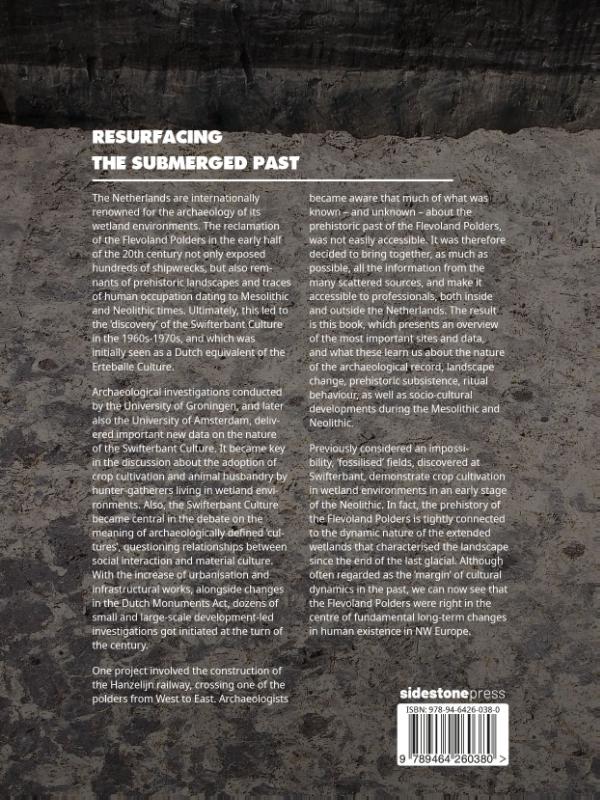
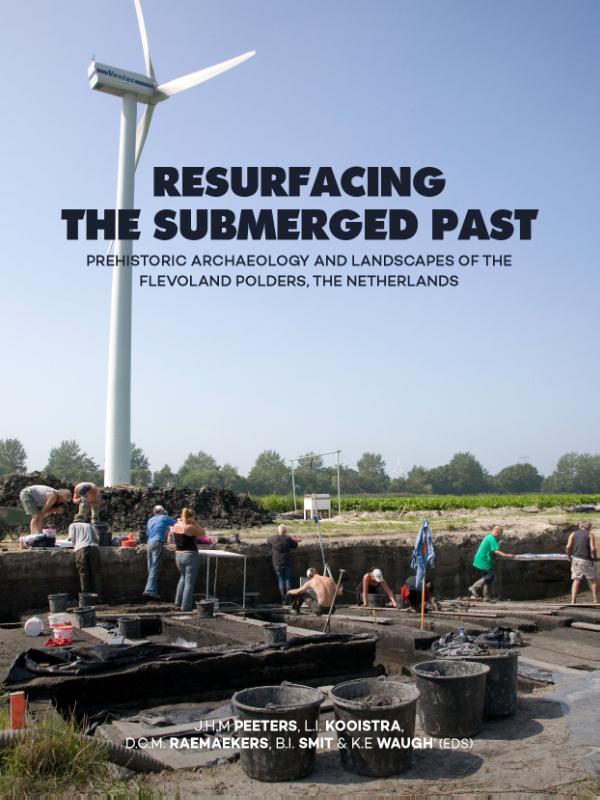
Resurfacing the submerged past Prehistoric archaeology and landscapes of the Flevoland Polders, the Netherlands
Paperback300 pagina’sEngels
Chapter 1 Introduction of the Hanzelijn Archaeological Project (K. E. Waugh (Ɨ), W. Hessing & J. Flamman)1.1 Organisation1.2 The archaeological project1.3 Knowledge Development Program Archaeology Hanzelijn 2012-20201.4 Some retrospective remarksChapter 2 The cradle of the Swifterbant culture: 50 years of archaeological investigations in the province of Flevoland (D.C.M Raemaekers & J.H.M. Peeters)2.1 Introduction2.2 History of the polders2.3 Research traditions in the polder2.4 Research topics and approaches2.5 The positioning of the Swifterbant Culture2.6 Archaeology and the public2.7 ConclusionsChapter 3 Hidden landscapes: mapping and evaluating deeply buried remains of human activity (J.H.M. Peeters & B.I. Smit)3.1 Introduction3.2 Climate, sea level rise and the structure of the subsurface3.3 The character and quality of archaeological remains3.4 Mapping hidden landscape units3.5 The identification of sites: on statistics and indicators3.6 Excavations: windows on the past3.7 ConclusionsChapter 4 Exploiting a changing landscape: subsistence, habitation and skills (J.H.M. Peeters, T. ten Anscher, L.I. Kooistra, L. Kubiak-Martens & J. Zeiler)4.1 Introduction4.2 Taphonomy and analysis: the representativeness and interpretive value of find assemblages4.3 Wild and domesticated mammals as sources of food4.4 Fishing in a drowning landscape4.5 Birds in the diet4.6 Plant resources in the food economy4.7 Food preparation and consumption4.8 Resources and technology4.9 Habitation patterns4.10 ConclusionsChapter 5 People, ritual and meaning (D.C.M Raemaekers)5.1 Introduction5.2 Burial practice5.3 Other cultural practices with human bones5.4 Depositions5.5 Materiality5.6 ConclusionsChapter 6 From land to water: geomorphological, hydrological and ecological developments in Flevoland from the Late Glacial to the end of the Subboreal (L.I. Kooistra & J.H.M. Peeters )6.1 Introduction6.2 Study of the history of the Flevoland landscape in broad outline6.3 Landscape dynamics in Flevoland6.4 A new view of the landscape6.5 Three windows of observation6.6 ConclusionsChapter 7 Transformations in a forager and farmer landscape: a cultural biography of prehistoric Flevoland (J.H.M. Peeters, L.I. Kooistra & D.C.M. Raemaekers)7.1 Introduction7.2 The landscape as a source of subsistence7.3 Cultural structuration of the environment7.4 Socio-cultural cohesion7.5 ConclusionsSite Atlas: Windows of observation: the quality, nature and context of excavated sites in Flevoland (T.Hamburg & B.I. Smit)I.1IntroductionI.2 Zuidelijke FlevolandI.2.1 Almere – Hoge Vaart/A27I.2.2 Almere – Europakwartier site 7I.2.3 Almere – ZwaanpadI.2.4 Zeewolde – Oz35/Oz36I.3 Oostelijk FlevolandI.3.1 Dronten N23/N307 – site 5I.3.2 Hanzelijn – Area VIIII.3.3 Hanzelijn – Tunnel Drontermeer (area XVI)I.3.4 SwifterbantclusterI.4 NoordoostpolderI.4.1 Emmeloord J97I.4.2 Schokkerhaven – E170I.4.3 Schokland P14I.4.4 Urk – E4BibliographyThe Netherlands are internationally renowned for the archaeology of its wetland environments. The reclamation of the Flevoland Polders in the early half of the 20th century not only exposed hundreds of shipwrecks, but also remnants of prehistoric landscapes and traces of human occupation dating to Mesolithic and Neolithic times. Ultimately, this led to the ‘discovery’ of the Swifterbant Culture in the 1960s-1970s, and which was initially seen as a Dutch equivalent of the Ertebølle Culture. Archaeological investigations conducted by the University of Groningen, and later also the University of Amsterdam, delivered important new data on the nature of the Swifterbant Culture. It became key in the discussion about the adoption of crop cultivation and animal husbandry by hunter-gatherers living in wetland environments. Also, the Swifterbant Culture became central in the debate on the meaning of archaeologically defined ‘cultures’, questioning relationships between social interaction and material culture. With the increase of urbanisation and infrastructural works, alongside changes in the Dutch Monuments Act, dozens of small and large-scale development-led investigations got initiated at the turn of the century. One project involved the construction of the Hanzelijn railway, crossing one of the polders from West to East. Archaeologists became aware that much of what was known – and unknown – about the prehistoric past of the Flevoland Polders, was not easily accessible. It was therefore decided to bring together, as much as possible, all the information from the many scattered sources, and make it accessible to professionals, both inside and outside the Netherlands. The result is this book, which presents an overview of the most important sites and data, and what these learn us about the nature of the archaeological record, landscape change, prehistoric subsistence, ritual behaviour, as well as socio-cultural developments during the Mesolithic and Neolithic. Previously considered an impossibility, ‘fossilised’ fields, discovered at Swifterbant, demonstrate crop cultivation in wetland environments in an early stage of the Neolithic. In fact, the prehistory of the Flevoland Polders is tightly connected to the dynamic nature of the extended wetlands that characterised the landscape since the end of the last glacial. Although often regarded as the ‘margin’ of cultural dynamics in the past, we can now see that the Flevoland Polders were right in the centre of fundamental long-term changes in human existence in NW Europe.
In het kort
ISBN-13
9789464260380
Uitgever
Verschenen
20 november 2021
Imprint
Bibliografisch
ISBN-139789464260380
Editie1
TaalEngels eng
Pagina’s300
GeïllustreerdJa
Uitgave
UitgeverSidestone Press
ImprintSidestone Press
CB-relatie-id9180064
Verschenen20 november 2021
StatusOnbekend 00
Vorm & inhoud
ProductvormPaperback BC
SamenstellingLos product
Classificatie
NUR (hoofd)Archeologie 682
NUR (alle)682 Archeologie
Medewerkers
Bewerker B05J.H.M. Peeters
Bewerker B05L.I. Kooistra
Bewerker B05D.C.M. Raemaekers
Bewerker B05B.J. Smit
Bewerker B05K.E. Waugh
Herkomst
Werk-id (NSTC)501469838
MeldingBevestigd bij publicatie 03
Bijgewerkt6 augustus 2026
Lijkt op dit boek
NSTC 501469838 · CB-relatie 9180064 · Bijgewerkt 6 augustus 2026