
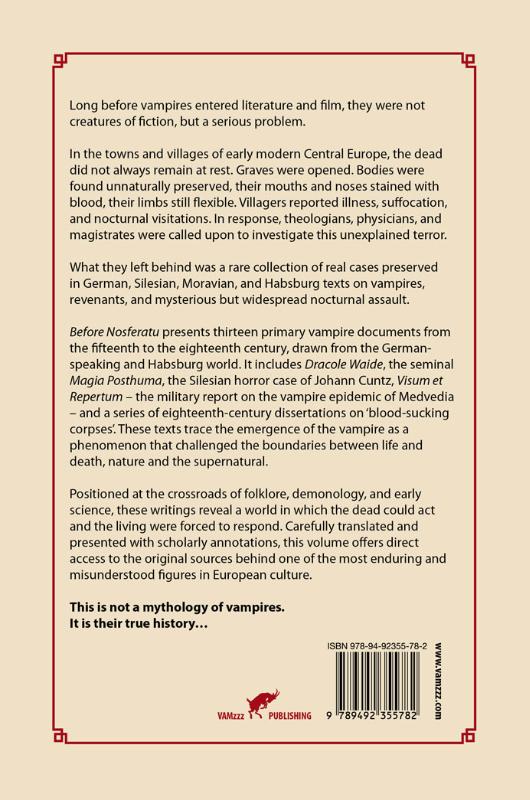
Before Nosferatu Historical Records of Vampires and Blood Drinking Corpses in Central Europe (1488–1742)
Benjamin Adamah vert.
Paperback380 pagina’sEngelsLeverbaar
contentsPreface – 9Introduction – 13I. The Dead who Refuse to Remain Dead – 13II. Silesia: The Pressing Dead and the Poltergeist Structure – 15III. Moravia and the Habsburg Zone: the Emergence of Medical Vampire Logic – 16IV. Serbia and the Balkans: the Consolidation of the Vampire – 17V. Christian Wolff and the Pressure of Rational Explanation – 18VI. The Vampires of Medvegia – 19VII. From Apparition to Corpse: the Formation of a Problem – 22PART I. Before the VampireCruelty, Revenants and the Unstable Dead (1488 – 1690) – 251. Die Geschicht Dracole Waide (1448) – 27The History of Dracole Waide Adolf Oswald (publisher)2.Historia, wie der Erstuerstorbene in Peste, die andern auffressen sol (1529–1600) – 38History of How the First to Die in a Plague Is Said to Devour the Others by Caspar Hennenberger3. Die entdeckte Nachtmär (1690) – 45The Revealed Night-Mare by Erasmus FrancisciPART II. The Pressing DeadSilesian Poltergeist Structures and the Istrian Strygon – 594. Johann Cuntzische Gespenster Historie (1737) – 62The Ghostly History of Johann Cuntze by Christian Stieff 5. Das X. Capittel: Von der Istrianer Sprache Sitten und Gewohnheiten (1689) – 89Chapter X: On the Language, Customs, and Habits of the Istrians by Johann Weichard von Valvasor (Janez Vajkard Valvasor)PART III. Magia Posthuma and the Transition to Corporeal VampirismThe Corpse Becomes Active – 1116. Magia Posthuma (1704) – 116Magic After Death by Karl Ferdinand de Schertz 7. Dissertatio prior Historico-Critica de Masticatione Mortuorum in Tumulis (1728) – 152Historical-Critical Dissertation on the Chewing of the Dead in Their Graves by Michael Ranfft 8. Dissertationem de Hominibus Post Mortem Sanguisugis, Vulgo Sic Dictis Vampyren (1732)– 206A Dissertation on Blood-Drinking Men After Death, Commonly Called Vampiresby Johann Gottlob Hertel & Johann Christoph Pohl 9. Dissertatio Physica de Cadaveribus Sanguisugis Vulgo Sic Appellatis Vampyris (1732) – 234Physical Dissertation on Blood-Drinking Corpses, Commonly Called Vampires by Johannes Christianus Stock & Johannes Guilielmus NöblingPART IV. The Habsburg Vampire DebatesMedicine, Law, Theology, and Early Enlightenment Critique – 24910. Visum et Repertum (1732) – 254Official Examination and Findings by Johann Adam Schmidt 11. Actenmäßige und Umständliche Relation von denen Vampiren oder Menschen-Saugern (1732) – 282Official and Detailed Report on the Vampires or Human Bloodsuckers by W. S. G. E.12. Besondere Nachricht von denen Vampyren oder so genannten Blut-Saugern (1732) – 310Remarkable Account of the Vampires, or So-Called Bloodsuckersby Johann Christoph Meinig13. Disquisitione de Vampyris (1742) – 338A Disquisition on Vampires by Georg Bernhard BilfingerPART V. Classifying The DeadToward a Theory of Vampiric Activity – 349I. Externally Active Revenants – 350II. The Masticating Dead – 351III. Diffuse and Non-Localized Vital Drain – 352IV. The Emergence of the Vampire as Composite Figure – 354Appendix I. Typology of Vampires, Revenants, Alp-Beings, and Nocturnal Affliction Spirits – 357Appendix II. Burial Practices Against the Restless Dead – 362Appendix III. Domestic Protection Systems in Central and South-East European Vampire Belief – 365Selected Bibliography (Antiquity – 1800) – 368Index – 370About the author – 376Long before vampires entered literature and film, they were not creatures of fiction, but a serious problem. This is not a mythology of vampires. It is their true history…Long before vampires entered literature and film, they were not creatures of fiction, but a serious problem.In the towns and villages of early modern Central Europe, the dead did not always remain at rest. Graves were opened. Bodies were found unnaturally preserved, their mouths and noses stained with blood, their limbs still flexible. Villagers reported illness, suffocation, and nocturnal visitations. In response, theologians, physicians, and magistrates were called upon to investigate this unexplained terror.What they left behind was a rare collection of real cases preserved in German, Silesian, Moravian, and Habsburg texts on vampires, revenants, and mysterious but widespread nocturnal assault.Before Nosferatu presents thirteen primary vampire documents from the fifteenth to the eighteenth century, drawn from the German-speaking and Habsburg world. It includes Dracole Waide, the seminal Magia Posthuma, the Silesian horror case of Johann Cuntz, Visum et Repertum – the military report on the vampire epidemic of Medvedia – and a series of eighteenth-century dissertations on ‘blood-sucking corpses’. These texts trace the emergence of the vampire as a phenomenon that challenged the boundaries between life and death, nature and the supernatural.Positioned at the crossroads of folklore, demonology, and early science, these writings reveal a world in which the dead could act and the living were forced to respond. Carefully translated and presented with scholarly annotations, this volume offers direct access to the original sources behind one of the most enduring and misunderstood figures in European culture.This is not a mythology of vampires.It is their true history…
In het kort
ISBN-13
9789492355782
Uitgever
Verschenen
11 juli 2026
Serie
Vampire Library · 1
Imprint
Bibliografisch
ISBN-139789492355782
SerieVampire Library — deel 1
Editie1
TaalEngels eng
Pagina’s380
GeïllustreerdJa
Uitgave
UitgeverVAMzzz Publishing
ImprintVAMzzz Publishing
CB-relatie-id6391696
Verschenen11 juli 2026
StatusLeverbaar 04
BeschikbaarheidBeschikbaar 20
Adviesprijs (incl. btw)€ 29,95
Vorm & inhoud
ProductvormPaperback BC
SamenstellingLos product
Classificatie
NUR (hoofd)Occultisme 725
NUR (alle)725 Occultisme
Medewerkers
Auteur A01Benjamin Adamah
Vertaler B06Benjamin Adamah
Herkomst
Werk-id (NSTC)501682772
MeldingUpdate 04
Laatste CB-bericht7807
Bijgewerkt18 augustus 2026
Lijkt op dit boek

NSTC 501682772 · CB-relatie 6391696 · Laatste CB-bericht 7807 · Bijgewerkt 18 augustus 2026