
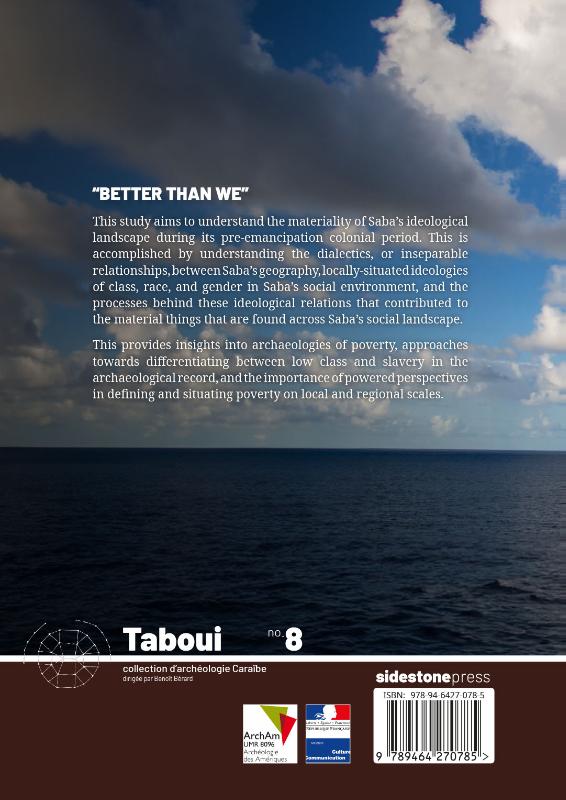
“Better Than We” Landscapes and materialities of race, class, and gender in pre-emancipation Saba, Dutch Caribbean
Ook verkrijgbaar als
Acknowledgements1 Friendly and Lovely, Though SmallBackground and approachThe problems with connecting materiality to landscapes, and ideology to materiality2 The SettingPositioning research locallyPositioning research regionallyConcluding remarks3 Theory and MethodologyIdeologyThe dialecticClassPovertyRaceGenderCapitalism as a heuristic device for colonial SabaThe socio-spatial dialecticInterpretation, sources, and postcolonialsmA theoretical structure for discerning the social and material vectors of class, race, and gender in pre-emancipation colonial SabaClosing remarks4 Saba in the Documentary RecordThe sources and their historySaba during the early colonial periodSaba during the seventeenth centurySaba during the eighteenth centurySaba during the nineteenth centurySaba into the twentieth centuryClosing remarks5 Excavated Plantation ContextsFieldwork proceduresExcavationFinds, features, and soilsOff-site processing of artifactsSite mappingSB 004: Spring Bay Sugar and Indigo PlantationSB 001: Flat Point Sugar and Indigo PlantationSB 002: Flat Point wellSB 003: Flat Point indigo vatsSB 007: Spring Bay FlatSB 038: Core Gut BayThe Bottom sugar plantationSaban plantations and the acquisition of slave labourSpatial analysis of sugar plantations as a means for identifying enslaved African housingEnslaved African dry stone houses in Caribbean contextsIndigo production on SabaClosing remarks6 Excavated Non-Plantation ContextsSB 037: The Fort Bay ridge siteSB 036: The Bottom privy pitSB 027: Palmetto PointSB 026: Middle IslandSB 039: Upper Hell’s Gate animal shelterSB 022: Little RendezvouzSB 050: Thais Hill trash pitSB 025: Cow Pasture village cisternClosing remarks7 Interpreting Race, Class, and Gender in Saba’s Domestic Spaces and Material CultureHousing, domestic architecture, and cisterns“The House”, class, and Saban cultureMaterial culture in eighteenth and nineteenth-century SabaDietBurial practices8 The Social and Material Vectors of Race, Class, and Gender in pre-Emancipation Colonial SabaSeascapes, landscapes, and the “incomplete hegemony”Landscapes of classLandscapes of raceLandscapes of genderClass in pre-emancipation colonial SabaRace and slavery in pre-emancipation colonial SabaGender in pre-emancipation colonial SabaInterpreting Saba’s landscapes of race, class, and gender in its pre-emancipation colonial archaeologyDifferentiating between poverty, slavery, and low class in pre-emancipation colonial SabaPerspectives of landscapes and povertiesClosing remarksReferencesAppendicesTablesSpring Bay boiling houseFlat Point boiling houseSpring Bay Flat boiling houseEnglish summarySamenvattingCurriculum VitaeThis study aims to understand the materiality of Saba’s ideological landscape during its pre-emancipation colonial period. This is accomplished by understanding the dialectics, or inseparable relationships, between Saba’s geography, locally-situated ideologies of class, race, and gender in Saba’s social environment, and the processes behind these ideological relations that contributed to the material things that are found across Saba’s social landscape. This provides insights into archaeologies of poverty, approaches towards differentiating between low class and slavery in the archaeological record, and the importance of powered perspectives in defining and situating poverty on local and regional scales.
In het kort
ISBN-13
9789464270785
Uitgever
Verschenen
28 december 2023
Serie
Imprint
Bibliografisch
Uitgave
UitgeverSidestone Press
ImprintSidestone Press Academics
CB-relatie-id9180064
Verschenen28 december 2023
StatusOnbekend 00
Vorm & inhoud
ProductvormPaperback BC
SamenstellingLos product
Classificatie
NUR (hoofd)Archeologie 682
NUR (alle)682 Archeologie
Medewerkers
Auteur A01Ryan Espersen
Herkomst
Werk-id (NSTC)501567686
MeldingBevestigd bij publicatie 03
Bijgewerkt6 augustus 2026
Lijkt op dit boek
Heritage, Landscape and Spatial Justice
Venezuelan Historical Archaeology
Archaeological Approaches to Inequality, Political Organisation, and Social Complexity
Environmental humanities: a rethinking of landscape archaeology?
Caribbean Cultural Heritage and the Nation
The early modern Zagori of Northwest Greece
Anacaona’s gift
Connectivity Matters!
Lucayan Legacies
Shaping Cultural Landscapes
NSTC 501567686 · CB-relatie 9180064 · Bijgewerkt 6 augustus 2026