
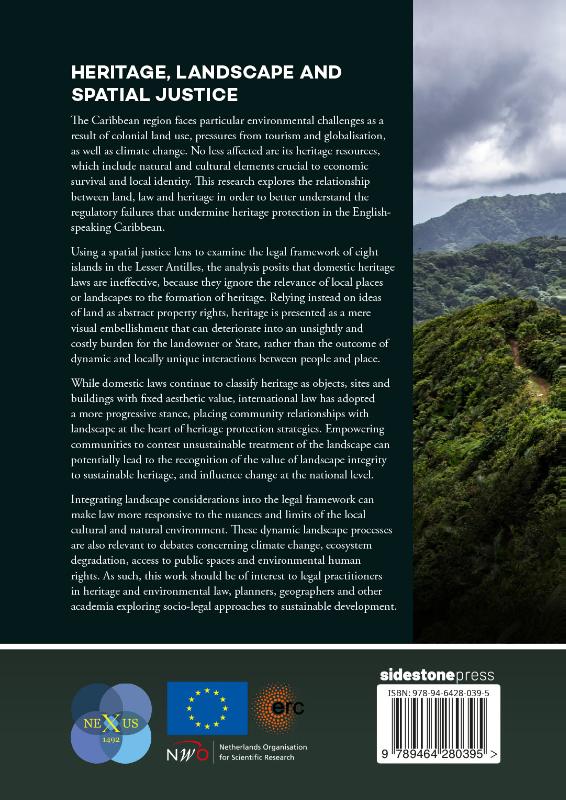
Heritage, Landscape and Spatial Justice New Legal Perspectives on Heritage Protection in the Lesser Antilles
Hardback200 pagina’sEngels
Ook verkrijgbaar als
AcknowledgmentsTable of LegislationList of FiguresList of AbbreviationsChapter 1 IntroductionChapter 2 Landscape: A Caribbean PerspectiveChapter 3 Landscape in International LawChapter 4 Antiquities and Heritage LegislationChapter 5 Planning LegislationChapter 6 National Parks and Protected Areas LegislationChapter 7 Examples of Conflicts over Landscape as Public SpaceChapter 8 ConclusionBibliographyCurriculum VitaeThe Caribbean region faces particular environmental challenges as a result of colonial land use, pressures from tourism and globalisation, as well as climate change. No less affected are its heritage resources, which include natural and cultural elements crucial to economic survival and local identity. This research explores the relationship between land, law and heritage in order to better understand the regulatory failures that undermine heritage protection in the English-speaking Caribbean. Using a spatial justice lens to examine the legal framework of eight islands in the Lesser Antilles, the analysis posits that domestic heritage laws are ineffective, because they ignore the relevance of local places or landscapes to the formation of heritage. Relying instead on ideas of land as abstract property rights, heritage is presented as a mere visual embellishment that can deteriorate into an unsightly and costly burden for the landowner or State, rather than the outcome of dynamic and locally unique interactions between people and place. While domestic laws continue to classify heritage as objects, sites and buildings with fixed aesthetic value, international law has adopted a more progressive stance, placing community relationships with landscape at the heart of heritage protection strategies. Empowering communities to contest unsustainable treatment of the landscape can potentially lead to the recognition of the value of landscape integrity to sustainable heritage, and influence change at the national level. Integrating landscape considerations into the legal framework can make law more responsive to the nuances and limits of the local cultural and natural environment. These dynamic landscape processes are also relevant to debates concerning climate change, ecosystem degradation, access to public spaces and environmental human rights. As such, this work should be of interest to legal practitioners in heritage and environmental law, planners, geographers and other academia exploring socio-legal approaches to sustainable development.
In het kort
ISBN-13
9789464280401
Uitgever
Verschenen
10 oktober 2022
Bibliografisch
ISBN-139789464280401
Editie1
TaalEngels eng
Pagina’s200
GeïllustreerdJa
Uitgave
Vorm & inhoud
ProductvormHardback BB
SamenstellingLos product
Classificatie
NUR (hoofd)Archeologie 682
NUR (alle)682 Archeologie
Medewerkers
Auteur A01Amanda Byer
Herkomst
Werk-id (NSTC)501501074
MeldingBevestigd bij publicatie 03
Bijgewerkt6 augustus 2026
Lijkt op dit boek
Environmental humanities: a rethinking of landscape archaeology?
Living (World) Heritage Cities
Everyday Heritage

Changes in the Cultural Landscape and their Impacts on Heritage Management
LDE Heritage Conference on Heritage and the Sustainable Development Goals

Troubled Waters

“Better Than We”

Sustainable tourism and law

Caribbean Cultural Heritage and the Nation

Lucayan Legacies
NSTC 501501074 · CB-relatie 9180064 · Bijgewerkt 6 augustus 2026