
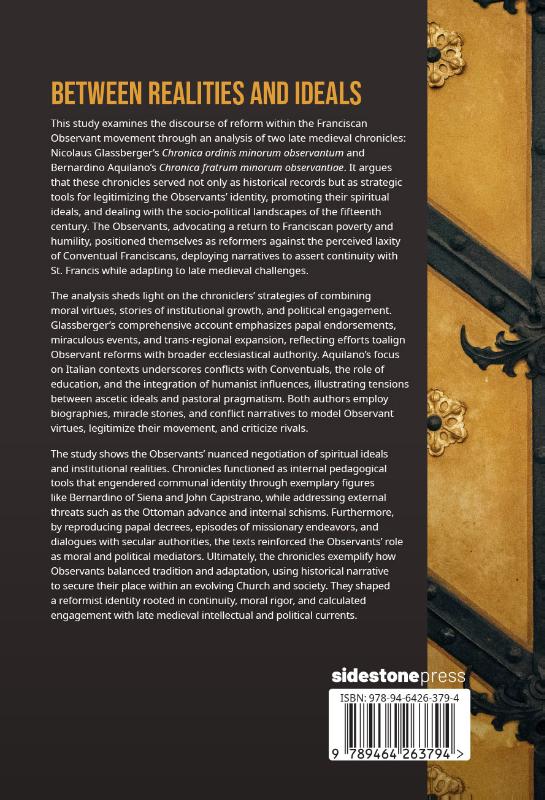
Between Realities and Ideals: Writing the Reform in Franciscan Observant Chronicles
Paperback140 pagina’sEngels
Ook verkrijgbaar als
IntroductionSources and scope of the present studyArgumentMethod and conceptsI. The Franciscan Observance: Development and IdealsI.1. The emergence of ObservanceI.2. The pillars of ObservanceI.3. Medieval discourses of virtues and reformI.4. Observant Modulations of the Medieval System of Moral VirtuesI.5. The Observants and the medieval discourses of powerII. The Observant Discourse of Reform: Legitimation, Education, and CommunicationII.1. The Observants and their efforts at institutional legitimationII.2. Integrating Education in the Observant Discourse of ReformII.2.1. Late medieval ideas of educationII.2.2. Between devotion and educationII.2.3. Observant mentors: Bernardino of Siena, John Capistrano, and their educational activitiesII.2.4. Education and humanismII.3. Communicating the Observant reformII.3.1. Communication oriented towards moralization: preaching and life-writingII.3.2. Communication for legitimization purposes: documents and lettersII.4.ConclusionIII. Observant Identity and its Chronicle FormsIII.1. Authorial fashioningIII.2. Narrating Franciscan institutional recognition and religious authorityIII.3. The Observants as viewed in the chroniclesIII.4. Ideals in the formation of Observant identity: from spiritual models to political powerIII.5. Balancing ideals and pragmatismIII.6. OthernessIII.6.1. The Other: Greeks, Tatars, and TurksIII.7. Narrative strategies in the formation of Observant identityIII.7.1. Types of chronicle narrativesIII.7.2. Narrative of events: from leadership-centered episodes to miraclesIII.7.3. Narrative of conflictsIII.7.4. BiographiesIII.7.5. Observant history: a dynamic enterprise and a story of continuityConclusion. Narrative constructions of Observant identity: between action and idealsBibliographyI. Primary SourcesII. Secondary LiteratureThis study examines the discourse of reform within the Franciscan Observant movement through an analysis of two late medieval chronicles: Nicolaus Glassberger’s Chronica ordinis minorum observantum and Bernardino Aquilano’s Chronica fratrum minorum observantiae. It argues that these chronicles served not only as historical records but as strategic tools for legitimizing the Observants’ identity, promoting their spiritual ideals, and dealing with the socio-political landscapes of the fifteenth century. The Observants, advocating a return to Franciscan poverty and humility, positioned themselves as reformers against the perceived laxity of Conventual Franciscans, deploying narratives to assert continuity with St. Francis while adapting to late medieval challenges.The analysis sheds light on the chroniclers’ strategies of combining moral virtues, stories of institutional growth, and political engagement. Glassberger’s comprehensive account emphasizes papal endorsements, miraculous events, and trans-regional expansion, reflecting efforts toalign Observant reforms with broader ecclesiastical authority. Aquilano’s focus on Italian contexts underscores conflicts with Conventuals, the role of education, and the integration of humanist influences, illustrating tensions between ascetic ideals and pastoral pragmatism. Both authors employ biographies, miracle stories, and conflict narratives to model Observant virtues, legitimize their movement, and criticize rivals.The study shows the Observants’ nuanced negotiation of spiritual ideals and institutional realities. Chronicles functioned as internal pedagogical tools that engendered communal identity through exemplary figures like Bernardino of Siena and John Capistrano, while addressing external threats such as the Ottoman advance and internal schisms. Furthermore, by reproducing papal decrees, episodes of missionary endeavors, and dialogues with secular authorities, the texts reinforced the Observants’ role as moral and political mediators. Ultimately, the chronicles exemplify how Observants balanced tradition and adaptation, using historical narrative to secure their place within an evolving Church and society. They shaped a reformist identity rooted in continuity, moral rigor, and calculated engagement with late medieval intellectual and political currents.
In het kort
ISBN-13
9789464263794
Uitgever
Verschenen
15 oktober 2025
Imprint
Bibliografisch
ISBN-139789464263794
Editie1
TaalEngels eng
Pagina’s140
GeïllustreerdNee
Uitgave
UitgeverSidestone Press
ImprintSidestone Press
CB-relatie-id9180064
Verschenen15 oktober 2025
StatusOnbekend 00
Vorm & inhoud
ProductvormPaperback BC
SamenstellingLos product
Classificatie
NUR (hoofd)Kerk- en dogmengeschiedenis 704
NUR (alle)704 Kerk- en dogmengeschiedenis
Medewerkers
Auteur A01Florin Leonte
Herkomst
Werk-id (NSTC)501626561
MeldingBevestigd bij publicatie 03
Bijgewerkt6 augustus 2026
Lijkt op dit boek
Religious institutes and catholic culture in 19th- and 20th-century europe
Aristotle and the Ontology of St. Bonaventure
Humble Women, Powerful Nuns
Life Inside the Cloister
Eloquent Images

The Use and Abuse of Sacred Places in Late Medieval Towns
Secular Power and Sacral Authority in Medieval East-Central Europe
Urban Developments in Late Antique and Medieval Rome
NSTC 501626561 · CB-relatie 9180064 · Bijgewerkt 6 augustus 2026