
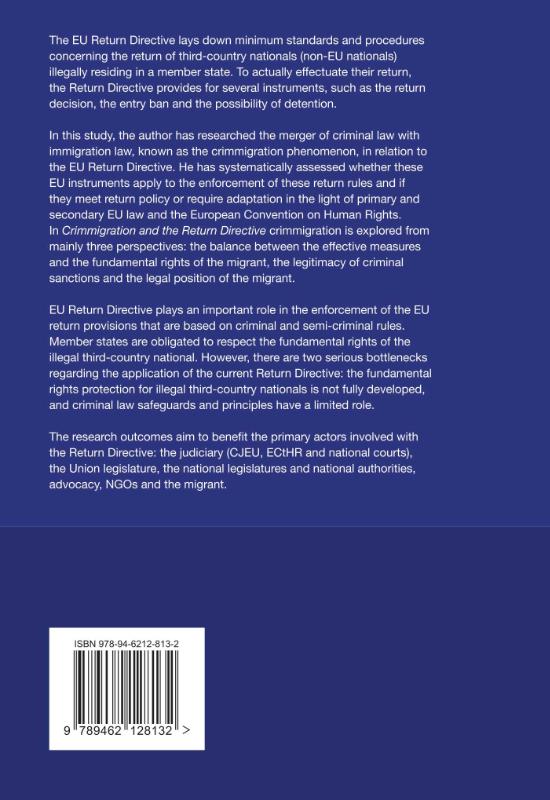
Preface xi 1 Introduction; 2 The Concept of Crimmigration Law; 3 Analysis of the Return Directive; 4 Analysis of the Return Decision; 5 Analysis of the Entry Ban; 6 Analysis of Detention; 7 Final Conclusions; BibliographyThe EU Return Directive lays down minimum standards and procedures concerning the return of third-country nationals (non-EU nationals) illegally residing in a member state. To actually effectuate their return, the Return Directive provides for several instruments, such as the return decision, the entry ban and the possibility of detention.In this study, the author has researched the merger of criminal law with immigration law, known as the crimmigration phenomenon, in relation to the EU Return Directive. He has systematically assessed whether these EU instruments apply to the enforcement of these return rules and if they meet return policy or require adaptation in the light of primary and secondary EU law and the European Convention on Human Rights. In Crimmigration and the Return Directive crimmigration is explored from mainly three perspectives: the balance between the effective measures and the fundamental rights of the migrant, the legitimacy of criminal sanctions and the legal position of the migrant.EU Return Directive plays an important role in the enforcement of the EU return provisions that are based on criminal and semi-criminal rules. Member states are obligated to respect the fundamental rights of the illegal third-country national. However, there are two serious bottlenecks regarding the application of the current Return Directive: the fundamental rights protection for illegal third-country nationals is not fully developed, and criminal law safeguards and principles have a limited role.The research outcomes aim to benefit the primary actors involved with the Return Directive: the judiciary (CJEU, ECtHR and national courts), the Union legislature, the national legislatures and national authorities, advocacy, NGOs and the migrant.
In het kort
ISBN-13
9789462128132
Uitgever
Verschenen
2 oktober 2023
Bibliografisch
ISBN-139789462128132
Editie1
TaalEngels eng
Pagina’s448
GeïllustreerdNee
Uitgave
UitgeverKoninklijke Boom uitgevers PW
CB-relatie-id7500275
Verschenen2 oktober 2023
StatusOnbekend 00
BeschikbaarheidContact leverancier 99
Zonder prijsPrijs volgt
Vorm & inhoud
ProductvormHardback BB
SamenstellingLos product
Classificatie
NUR (hoofd)Internationaal (publiek)recht 828
NUR (alle)828 Internationaal (publiek)recht
Trefwoordencriminal law · adoption · return · illegal · eu · european union · crimmigration · migrant · territory · recast · voluntary departure · detention · fundamental rights
Medewerkers
Auteur A01A. Pahladsingh
Herkomst
Werk-id (NSTC)501537236
MeldingUpdate 04
Laatste CB-bericht7794
Bijgewerkt7 augustus 2026
Trefwoorden
Lijkt op dit boek
Crimmigration law in the European Union, Part 2
Crimmigration law in the European Union
Detection, Detention, Deportation

The single permit directive
The Migration Crisis?
The Students & Researchers Directive
The recast reception conditions directive
The rule of law in the external dimension of EU migration and asylum policy
The human rights of migrant women in International and European Law
The Protection of Fundamental Rights in Composite Banking Supervision Procedures
NSTC 501537236 · CB-relatie 7500275 · Laatste CB-bericht 7794 · Bijgewerkt 7 augustus 2026