
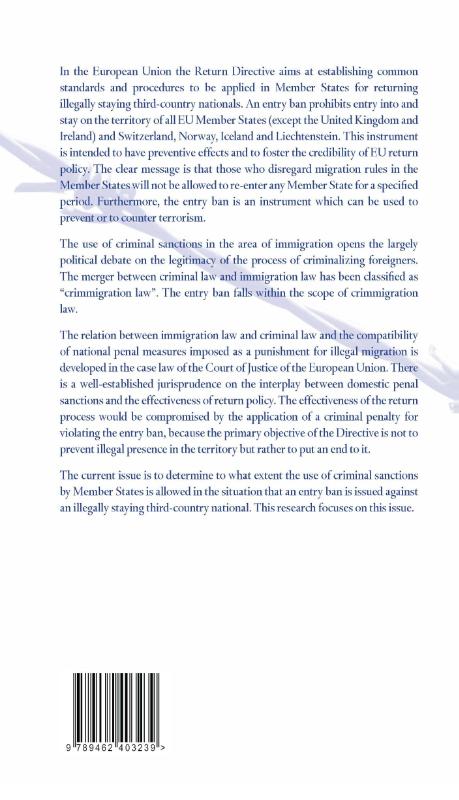
Crimmigration law in the European Union the return directive and the entry ban
Paperback90 pagina’sEngels
In the European Union the Return Directive aims at establishing common standards and procedures to be applied in Member States for returning illegally staying third-country nationals. An entry ban prohibits entry into and stay on the territory of all EU Member States (except the United Kingdom and Ireland) and Switzerland, Norway, Iceland and Liechtenstein. This instrument is intended to have preventive effects and to foster the credibility of EU return policy. The clear message is that those who disregard migration rules in the Member States will not be allowed to re-enter any Member State for a specified period. Furthermore, the entry ban is an instrument which can be used to prevent or to counter terrorism.
The use of criminal sanctions in the area of immigration opens the largely political debate on the legitimacy of the process of criminalizing foreigners. The merger between criminal law and immigration law has been classified as "crimmigration law". The entry ban falls within the scope of crimmigration law.
The relation between immigration law and criminal law and the compatibility of national penal measures imposed as a punishment for illegal migration is developed in the case law of the Court of Justice of the European Union. There is a well-established jurisprudence on the interplay between domestic penal sanctions and the effectiveness of return policy. The effectiveness of the return process would be compromised by the application of a criminal penalty for violating the entry ban, because the primary objective of the Directive is not to prevent illegal presence in the territory but rather to put an end to it.
The current issue is to determine to what extent the use of criminal sanctions by Member States is allowed in the situation that an entry ban is issued against an illegally staying third-country national. This research focuses on this issue.
The use of criminal sanctions in the area of immigration opens the largely political debate on the legitimacy of the process of criminalizing foreigners. The merger between criminal law and immigration law has been classified as "crimmigration law". The entry ban falls within the scope of crimmigration law.
The relation between immigration law and criminal law and the compatibility of national penal measures imposed as a punishment for illegal migration is developed in the case law of the Court of Justice of the European Union. There is a well-established jurisprudence on the interplay between domestic penal sanctions and the effectiveness of return policy. The effectiveness of the return process would be compromised by the application of a criminal penalty for violating the entry ban, because the primary objective of the Directive is not to prevent illegal presence in the territory but rather to put an end to it.
The current issue is to determine to what extent the use of criminal sanctions by Member States is allowed in the situation that an entry ban is issued against an illegally staying third-country national. This research focuses on this issue.
In het kort
ISBN-13
9789462403239
Uitgever
Verschenen
11 juli 2016
Imprint
Bibliografisch
ISBN-139789462403239
Editie1
TaalEngels eng
Pagina’s90
GeïllustreerdNee
Uitgave
UitgeverWolf Legal Publishers
ImprintWolf legal publishers
CB-relatie-id8037459
Verschenen11 juli 2016
StatusOnbekend 00
Vorm & inhoud
ProductvormPaperback BC
SamenstellingLos product
Classificatie
NUR (hoofd)Recht algemeen 820
NUR (alle)820 Recht algemeen
Medewerkers
Auteur A01Aniel Pahladsingh
Auteur A01Jim Waasdorp
Herkomst
Werk-id (NSTC)500419109
MeldingBevestigd bij publicatie 03
Bijgewerkt6 augustus 2026
Lijkt op dit boek

Crimmigration law in the European Union, Part 2
Crimmigration and the Return Directive
Detection, Detention, Deportation

The single permit directive

Social control and justice

The Migration Crisis?
The rule of law in the external dimension of EU migration and asylum policy
The recast reception conditions directive
The Students & Researchers Directive
NSTC 500419109 · CB-relatie 8037459 · Bijgewerkt 6 augustus 2026