
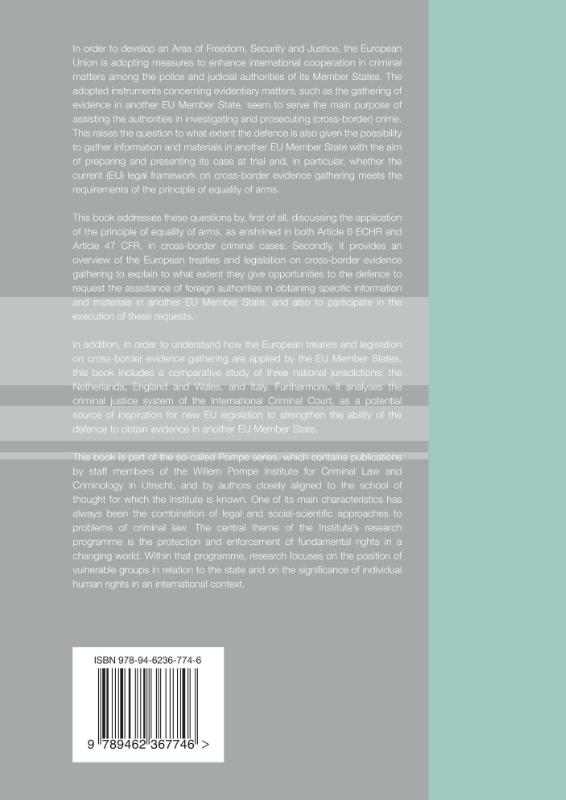
Cross-border evidence gathering equality of arms within the EU?
Ook verkrijgbaar als
In order to develop an Area of Freedom, Security and Justice, the EuropeanUnion is adopting measures to enhance international cooperation in criminalmatters among the police and judicial authorities of its Member States. Theadopted instruments concerning evidentiary matters, such as the gathering ofevidence in another EU Member State, seem to serve the main purpose ofassisting the authorities in investigating and prosecuting (cross-border) crime. This raises the question to what extent the defence is also given the possibility to gather information and materials in another EU Member State with the aim of preparing and presenting its case at trial and, in particular, whether the current (EU) legal framework on cross-border evidence gathering meets the requirements of the principle of equality of arms. This book addresses these questions by, first of all, discussing the application of the principle of equality of arms, as enshrined in both Article 6 ECHR and Article 47 CFR, in cross-border criminal cases. Secondly, it provides an overview of the European treaties and legislation on cross-border evidence gathering to explain to what extent they give opportunities to the defence to request the assistance of foreign authorities in obtaining specific information and materials in another EU Member State, and also to participate in the execution of these requests.In addition, in order to understand how the European treaties and legislation on cross-border evidence gathering are applied by the EU Member States, this book includes a comparative study of three national jurisdictions: the Netherlands, England and Wales, and Italy. Furthermore, it analyses the criminal justice system of the International Criminal Court, as a potential source of inspiration for new EU legislation to strengthen the ability of the defence to obtain evidence in another EU Member State.This book is part of the so-called Pompe series, which contains publicationsby staff members of the Willem Pompe Institute for Criminal Law andCriminology in Utrecht, and by authors closely aligned to the school ofthought for which the Institute is known. One of its main characteristics has always been the combination of legal and social-scientific approaches toproblems of criminal law. The central theme of the Institute's researchprogramme is the protection and enforcement of fundamental rights in achanging world. Within that programme, research focuses on the position ofvulnerable groups in relation to the state and on the significance of individual human rights in an international context.
In het kort
ISBN-13
9789462367746
Uitgever
Verschenen
18 juli 2017
Serie
Bibliografisch
Uitgave
UitgeverKoninklijke Boom uitgevers PW
CB-relatie-id7500275
Verschenen18 juli 2017
StatusOnbekend 00
BeschikbaarheidContact leverancier 99
Adviesprijs (incl. btw)€ 62,50
Vorm & inhoud
ProductvormPaperback BC
SamenstellingLos product
Classificatie
NUR (hoofd)Algemene sociale wetenschappen 741
NUR (alle)741 Algemene sociale wetenschappen
Medewerkers
Auteur A01Marloes C. van Wijk
Herkomst
Werk-id (NSTC)500091386
MeldingBevestigd bij publicatie 03
Bijgewerkt6 augustus 2026
Lijkt op dit boek
Choice of forum in cooperation against EU financial crime
Disclosure of information in criminal proceedings
Shifting responsibilities in criminal justice
Collaboration with Justice in the Netherlands, Germany, Italy and Canada
Of swords and shields: due process and crime control in times of globalization

The Right to a Fair Trial in International Criminal Proceedings
Cross-border Access to Electronic Evidence
European Arrest Warrant
Mutual Trust under Pressure, the Transferring of Sentenced Persons in the EU
The Transfer of Criminal Proceedings in the European Union
NSTC 500091386 · CB-relatie 7500275 · Bijgewerkt 6 augustus 2026