
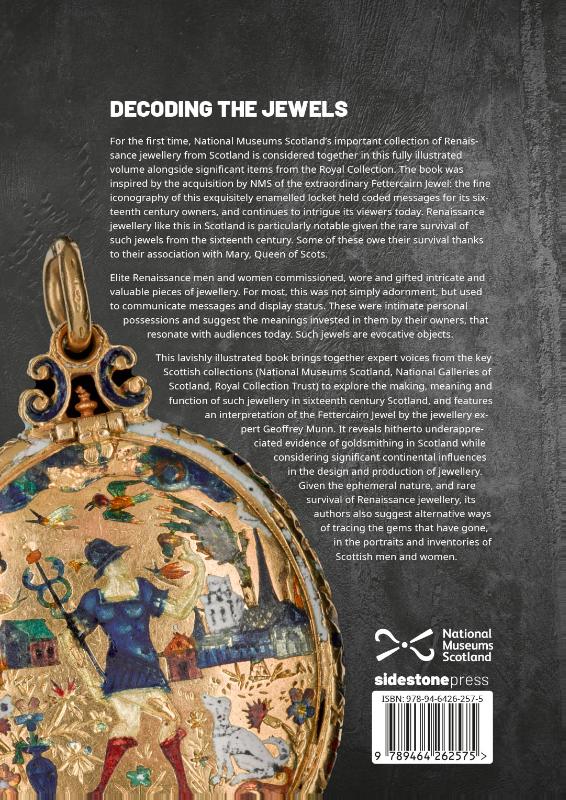
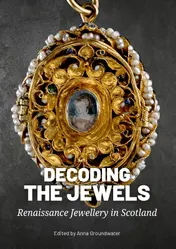
Decoding the Jewels Renaissance Jewellery in Scotland
Hardback210 pagina’sEngels
Author biographiesList of Figures and TablesAcknowledgementsForewordSam J.M.M. Alberti, Director of Collections, National Museums Scotland1. The Renaissance in Scotland: historical and cultural contextsAnna Groundwater, Principal Curator, Renaissance and Early Modern History, National Museums Scotland2. The Fettercairn Jewel – An InterpretationGeoffrey Munn, Art historian and jewellery specialist3. The Mystery of the Fettercairn JewelHelen Wyld, Senior Curator of Historic Textiles, National Museums Scotland4. ‘A Most Extraordinary and Very Curious Jewel’: the Darnley or Lennox JewelDeborah Clarke, former Senior Curator, Holyroodhouse Palace, Royal Collection Trust5. Scottish Renaissance Jewels in the National Collection: making and makersLyndsay McGill, former Curator, Renaissance and Early Modern History, National Museums Scotland6. Jewels in Sixteenth-Century Scottish PortraitsKate Anderson, Senior Curator, National Galleries of Scotland7. Tracing Royal Stewart Jewels in the ArchivesAnna Groundwater8. Analysis of the Fettercairn Jewel and other late sixteenth century Renaissance jewellery items associated with ScotlandLore Troalen, Analytical Scientist, National Museums ScotlandFor the first time, National Museums Scotland’s important collection of Renaissance jewellery from Scotland is considered together in this fully illustrated volume alongside significant items from the Royal Collection. The book was inspired by the acquisition by NMS of the extraordinary Fettercairn Jewel: the fine iconography of this exquisitely enamelled locket held coded messages for its sixteenth century owners, and continues to intrigue its viewers today. Renaissance jewellery like this in Scotland is particularly notable given the rare survival of such jewels from the sixteenth century. Some of these owe their survival thanks to their association with Mary, Queen of Scots. Elite Renaissance men and women commissioned, wore and gifted intricate and valuable pieces of jewellery. For most, this was not simply adornment, but used to communicate messages and display status. These were intimate personal possessions and suggest the meanings invested in them by their owners, that resonate with audiences today. Such jewels are evocative objects. This lavishly illustrated book brings together expert voices from the key Scottish collections (National Museums Scotland, National Galleries of Scotland, Royal Collection Trust) to explore the making, meaning and function of such jewellery in sixteenth century Scotland, and features an interpretation of the Fettercairn Jewel by the jewellery expert Geoffrey Munn. It reveals hitherto underappreciated evidence of goldsmithing in Scotland while considering significant continental influences in the design and production of jewellery. Given the ephemeral nature, and rare survival of Renaissance jewellery, its authors also suggest alternative ways of tracing the gems that have gone, in the portraits and inventories of Scottish men and women.
In het kort
ISBN-13
9789464262582
Uitgever
Verschenen
2 mei 2024
Imprint
Bibliografisch
ISBN-139789464262582
Editie1
TaalEngels eng
Pagina’s210
GeïllustreerdJa
Uitgave
UitgeverSidestone Press
ImprintSidestone Press
CB-relatie-id9180064
Verschenen2 mei 2024
StatusOnbekend 00
Vorm & inhoud
ProductvormHardback BB
SamenstellingLos product
Classificatie
NUR (hoofd)Kunstgeschiedenis 654
NUR (alle)654 Kunstgeschiedenis
Medewerkers
Bewerker B05Anna Groundwater
Herkomst
Werk-id (NSTC)501571673
MeldingBevestigd bij publicatie 03
Bijgewerkt6 augustus 2026
Lijkt op dit boek
NSTC 501571673 · CB-relatie 9180064 · Bijgewerkt 6 augustus 2026