
European integration through member states’ constitutional identity in EU law
Paperback214 pagina’sEngelsLeverbaar
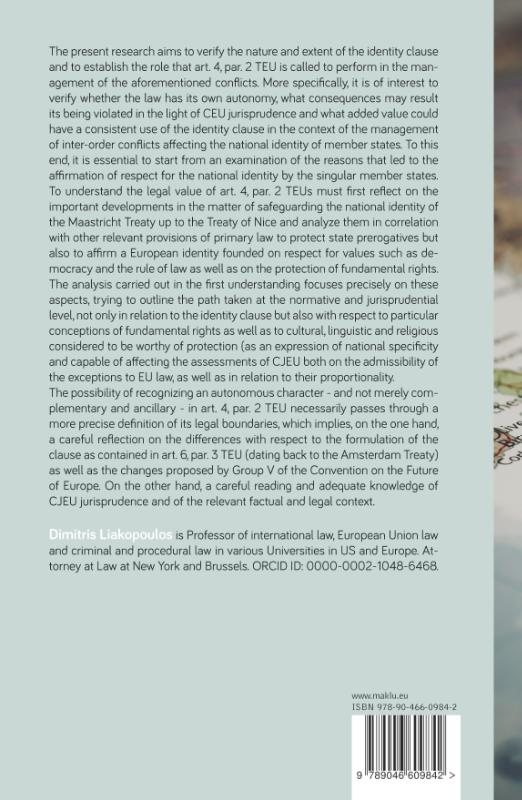
The present research aims to verify the nature and extent of the identity clauseand to establish the role that art. 4, par. 2 TEU is called to perform in the management of the aforementioned conflicts. More specifically, it is of interest to verify whether the law has its own autonomy, what consequences may resultits being violated in the light of CEU jurisprudence and what added value couldhave a consistent use of the identity clause in the context of the managementof inter-order conflicts affecting the national identity of member states. To this end, it is essential to start from an examination of the reasons that led to the affirmation of respect for the national identity by the singular member states.To understand the legal value of art. 4, par. 2 TEUs must first reflect on theimportant developments in the matter of safeguarding the national identity ofthe Maastricht Treaty up to the Treaty of Nice and analyze them in correlationwith other relevant provisions of primary law to protect state prerogatives butalso to affirm a European identity founded on respect for values such as democracy and the rule of law as well as on the protection of fundamental rights.The analysis carried out in the first understanding focuses precisely on theseaspects, trying to outline the path taken at the normative and jurisprudentiallevel, not only in relation to the identity clause but also with respect to particular conceptions of fundamental rights as well as to cultural, linguistic and religious considered to be worthy of protection (as an expression of national specificity and capable of affecting the assessments of CJEU both on the admissibility of the exceptions to EU law, as well as in relation to their proportionality.The possibility of recognizing an autonomous character - and not merely complementary and ancillary - in art. 4, par. 2 TEU necessarily passes through amore precise definition of its legal boundaries, which implies, on the one hand,a careful reflection on the differences with respect to the formulation of theclause as contained in art. 6, par. 3 TEU (dating back to the Amsterdam Treaty)as well as the changes proposed by Group V of the Convention on the Futureof Europe. On the other hand, a careful reading and adequate knowledge ofCJEU jurisprudence and of the relevant factual and legal context.Dimitris Liakopoulos is Professor of international law, European Union lawand criminal and procedural law in various Universities in US and Europe. Attorney at Law at New York and Brussels. ORCID ID: 0000-0002-1048-6468.
In het kort
ISBN-13
9789046609842
Uitgever
Verschenen
28 mei 2019
Bibliografisch
ISBN-139789046609842
Editie1
TaalEngels eng
Pagina’s214
GeïllustreerdNee
Uitgave
UitgeverMaklu Uitgevers N.V.
CB-relatie-id8397719
Verschenen28 mei 2019
StatusLeverbaar 04
BeschikbaarheidBeschikbaar 20
Adviesprijs (incl. btw)€ 45,00
Vorm & inhoud
ProductvormPaperback BC
SamenstellingLos product
Classificatie
NUR (hoofd)Internationaal (publiek)recht 828
NUR (alle)828 Internationaal (publiek)recht
Medewerkers
Auteur A01Dimitris Liakopoulos
Herkomst
MeldingBevestigd bij publicatie 03
Bijgewerkt6 augustus 2026
Lijkt op dit boek

The Case of Congo: Are Basic Human Rights Merely a Thin Veneer for the Public?

Winx Club - Paniek op de toverschool
Volume III International and European Private Law
Volume I International and European Law
Volume II Comparative Public Law
Volume IV
Volume I-IV

Internationaal publiekrecht als wereldrecht
Cases and Materials European Union Law
Protecting the Public Interest in Times of Climate Change: From Abandoning Fossil Fuel to Sharing our Earth
CB-relatie 8397719 · Bijgewerkt 6 augustus 2026