
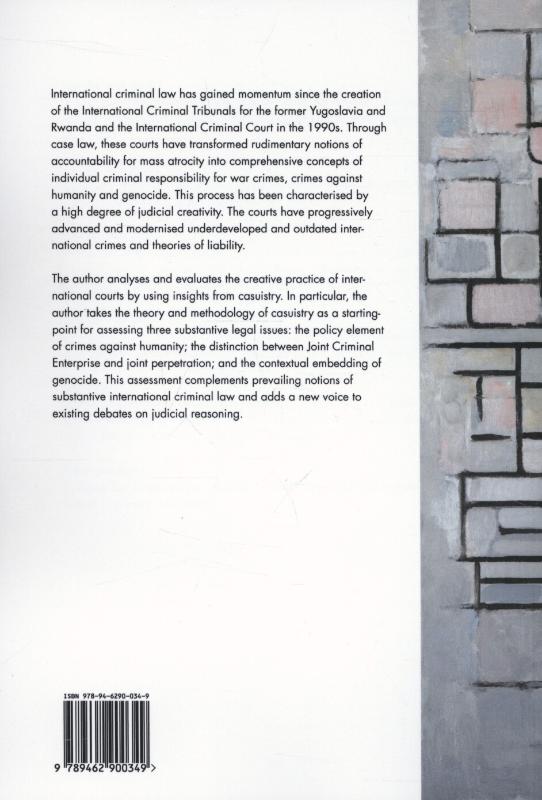
Facts matter a study into the casuistry of substantive international criminal law
PaperbackNederlands
Ook verkrijgbaar als
International criminal law has gained momentum since the creation of the International Criminal Tribunals for the former Yugoslavia and Rwanda and the International Criminal Court in the 1990s. Through case law, these courts have transformed rudimentary notions of accountability for mass atrocity into comprehensive concepts of individual criminal responsibility for war crimes, crimes against humanity and genocide. This process has been characterised by a high degree of judicial creativity. The courts have progressively advanced and modernised underdeveloped and outdated international crimes and theories of liability.The author analyses and evaluates the creative practice of international courts by using insights from casuistry. In particular, the author takes the theory and methodology of casuistry as a starting point for assessing three substantive legal issues: the policy element of crimes against humanity; the distinction between Joint Criminal Enterprise and joint perpetration; and the contextual embedding of genocide. This assessment complements prevailing notions of substantive international criminal law and adds a new voice to existing debates on judicial reasoning.
In het kort
ISBN-13
9789462900349
Uitgever
Verschenen
3 maart 2015
Bibliografisch
ISBN-139789462900349
Editie1
TaalNederlands dut
GeïllustreerdJa
Uitgave
UitgeverKoninklijke Boom uitgevers PW
CB-relatie-id7500275
Verschenen3 maart 2015
StatusOnbekend 00
BeschikbaarheidContact leverancier 99
Adviesprijs (incl. btw)€ 65,00
Vorm & inhoud
ProductvormPaperback BC
SamenstellingLos product
Classificatie
NUR (hoofd)Strafrecht en procesrecht 824
NUR (alle)824 Strafrecht en procesrecht
Medewerkers
Auteur A01Marjolein Cupido
Herkomst
Werk-id (NSTC)100029957
MeldingBevestigd bij publicatie 03
Bijgewerkt6 augustus 2026
Lijkt op dit boek
The mental element in the Rome statute of the international criminal court
The right to reparations under the rome statute of the international criminal court icc
The function of accusation in International Criminal Court
Hybride overname van strafvervolging

Aspects of Transitional Justice and Human Rights

The Protection of Victims and Witnesses at International and Internationalized Criminal Courts - the example of the ECCC
Dialectiek van nationaal en internationaal strafrecht

Opstellen materieel strafrecht
Misdaden tegen de mensheid
Internationaal humanitair strafrecht
NSTC 100029957 · CB-relatie 7500275 · Bijgewerkt 6 augustus 2026