
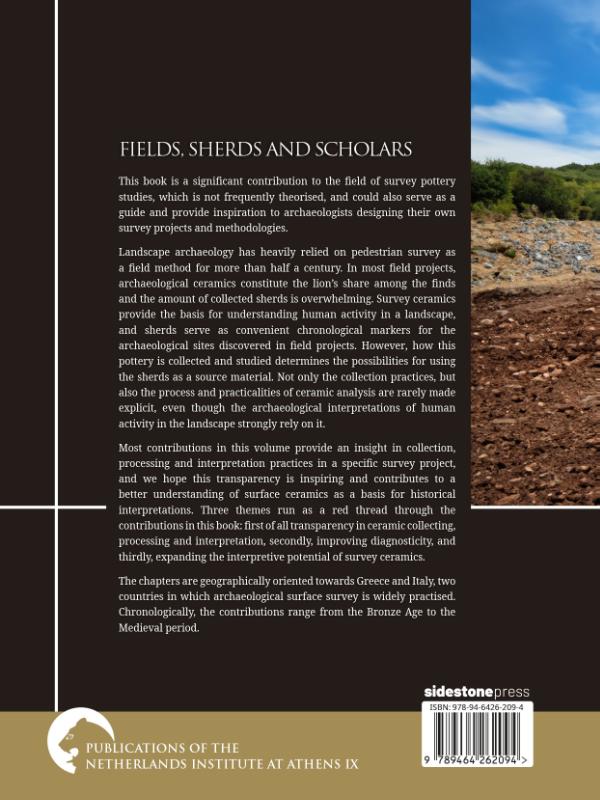
Fields, Sherds and Scholars Recording and Interpreting Survey Ceramics
Survey ceramics in the spotlightAnna Meens, Margarita Nazou & Winfred van de PutPottery studies in survey in the eastern Mediterranean over the last 20 years – a personal accountKristina Winther-JacobsenStatistical distances on a map (STADION): a method for exploring intra-site variability of pottery assemblagesJesús García SánchezDiagnostic visibility and problems of quantification in survey assemblages. Examples from the Mazi archaeological project (Northwest Attica)Christian F. Cloke, Alex R. Knodell, Sylvian Fachard & Kalliopi PapangeliDown to the details. The pottery recording methodology from the Kea Archaeological Research SurveyMargarita Nazou, Joanne Murphy, Natalie Abell, Shannon LaFayette Hogue & John WallrodtThe potential of impasto pottery studies for understanding regional settlement dynamics, cultural transmission and connectivity in Bronze Age landscapes in ItalyFrancesca Ippolito & Peter AttemaSurvey, ceramics and statistics: the potential for technological traits as chronological markersAyla Krijnen, Jitte Waagen & Jill HilditchThe analytical potential of intensive field survey data: developments in the collection, analysis and interpretation of surface ceramics within the Pontine Region ProjectTymon de Haas & Gijs TolThe Ayios Vasileios Survey Project: diagnostic samples versus total samples and their biasesCorien W. WiersmaDiagnosing the undiagnostic. Using sherd databases as a source of interpretationVladimir StissiTales of two cities. Urban surveys of the Hellenistic and Roman cities of Sikyon and KnossosConor P. Trainor & Peter J. StoneA case in point(s). The Late Hellenistic to Late Roman pottery from extra-mural Tanagra and the formation of the surface record: methodology, chronology and functionDean Peeters, Philip Bes & Jeroen PoblomeBuried landscapes and landscapes of the buried. Considering rural burial in surveyAnna MeensThis book is a significant contribution to the field of survey pottery studies, which is not frequently theorised, and could also serve as a guide and provide inspiration to archaeologists designing their own survey projects and methodologies. Landscape archaeology has heavily relied on pedestrian survey as a field method for more than half a century. In most field projects, archaeological ceramics constitute the lion’s share among the finds and the amount of collected sherds is overwhelming. Survey ceramics provide the basis for understanding human activity in a landscape, and sherds serve as convenient chronological markers for the archaeological sites discovered in field projects. However, how this pottery is collected and studied determines the possibilities for using the sherds as a source material. Not only the collection practices, but also the process and practicalities of ceramic analysis are rarely made explicit, even though the archaeological interpretations of human activity in the landscape strongly rely on it. Most contributions in this volume provide an insight in collection, processing and interpretation practices in a specific survey project, and we hope this transparency is inspiring and contributes to a better understanding of surface ceramics as a basis for historical interpretations. Three themes run as a red thread through the contributions in this book: first of all transparency in ceramic collecting, processing and interpretation, secondly, improving diagnosticity, and thirdly, expanding the interpretive potential of survey ceramics. The chapters are geographically oriented towards Greece and Italy, two countries in which archaeological surface survey is widely practised. Chronologically, the contributions range from the Bronze Age to the Medieval period.
In het kort
ISBN-13
9789464262100
Uitgever
Verschenen
7 december 2023
Imprint
Bibliografisch
ISBN-139789464262100
SeriePublications of the Netherlands Institute at Athens — deel 9
Editie1
TaalEngels eng
Pagina’s160
GeïllustreerdJa
Uitgave
UitgeverSidestone Press
ImprintSidestone Press
CB-relatie-id9180064
Verschenen7 december 2023
StatusOnbekend 00
Vorm & inhoud
ProductvormHardback BB
SamenstellingLos product
Classificatie
NUR (hoofd)Archeologie 682
NUR (alle)682 Archeologie
Medewerkers
Herkomst
Werk-id (NSTC)501557213
MeldingBevestigd bij publicatie 03
Bijgewerkt6 augustus 2026
Lijkt op dit boek
Roman Pottery in the Low Countries
Spatial Patterns in Landscape Archaeology
Between variability and singularity
Documenting Ancient Sagalassos

Serial Learners
Shaping Cultural Landscapes
Artefact Biographies from Mesolithic and Neolithic Europe and Beyond
The potters’ perspectives
How things make history
The Archaeology of the ‘Margins’
NSTC 501557213 · CB-relatie 9180064 · Bijgewerkt 6 augustus 2026