
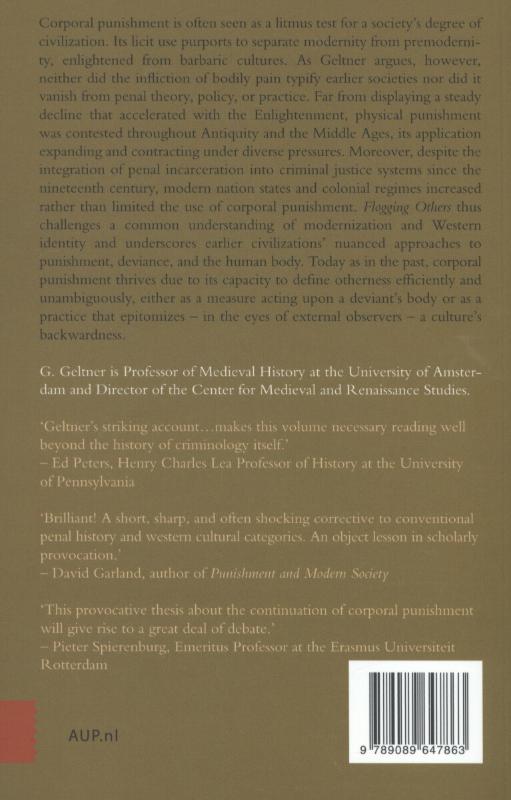
Flogging Others corporal punishment and cultural identity from antiquity to the present
PaperbackEngels
Ook verkrijgbaar als
Introduction [-]1. Historical and Anthropological Approaches[-]Problems of Definition[-]Problems of Interpretation[-]2. Punishing Bodies[-]Antiquity[-]Later Antiquity[-]Religion and Punishment[-]Medieval and Early Modern Europe[-]Modernity to the Present[-]Conclusion[-]Acknowledgements[-]Notes[-]Works Cited[-]Index[-]Nederlandse editie leverbaar: De gesel en de ander (ISBN 978 90 8964 787 0).Corporal punishment is often seen as a litmus test for a society's degree of civilization. Its licit use purports to separate modernity from premodernity, enlightened from barbaric cultures. As Geltner argues, however, neither did the infliction of bodily pain typify earlier societies nor did it vanish from penal theory, policy, or practice. Far from displaying a steady decline that accelerated with the Enlightenment, physical punishment was contested throughout Antiquity and the Middle Ages, its application expanding and contracting under diverse pressures. Moreover, despite the integration of penal incarceration into criminal justice systems since the nineteenth century, modern nation states and colonial regimes increased rather than limited the use of corporal punishment. Flogging Others thus challenges a common understanding of modernization and Western identity and underscores earlier civilizations' nuanced approaches to punishment, deviance, and the human body. Today as in the past, corporal punishment thrives due to its capacity to define otherness efficiently and unambiguously, either as a measure acting upon a deviant's body or as a practice that epitomizes - in the eyes of external observers - a culture'sbackwardness.
In het kort
ISBN-13
9789089647863
Uitgever
Verschenen
13 november 2014
Imprint
Bibliografisch
ISBN-139789089647863
Editie1
TaalEngels eng
GeïllustreerdJa
Uitgave
UitgeverAmsterdam University Press
ImprintAmsterdam University Press
CB-relatie-id7400597
Verschenen13 november 2014
StatusInactief 08
BeschikbaarheidContact leverancier 99
Adviesprijs (incl. btw)€ 13,99
Vorm & inhoud
ProductvormPaperback BC
SamenstellingLos product
Classificatie
NUR (hoofd)Cultuur- en mentaliteitsgeschiedenis 694
NUR (alle)694 Cultuur- en mentaliteitsgeschiedenis
Medewerkers
Auteur A01G. Geltner
Herkomst
Werk-id (NSTC)100029551
MeldingBevestigd bij publicatie 03
Bijgewerkt6 augustus 2026
Lijkt op dit boek









NSTC 100029551 · CB-relatie 7400597 · Bijgewerkt 6 augustus 2026