
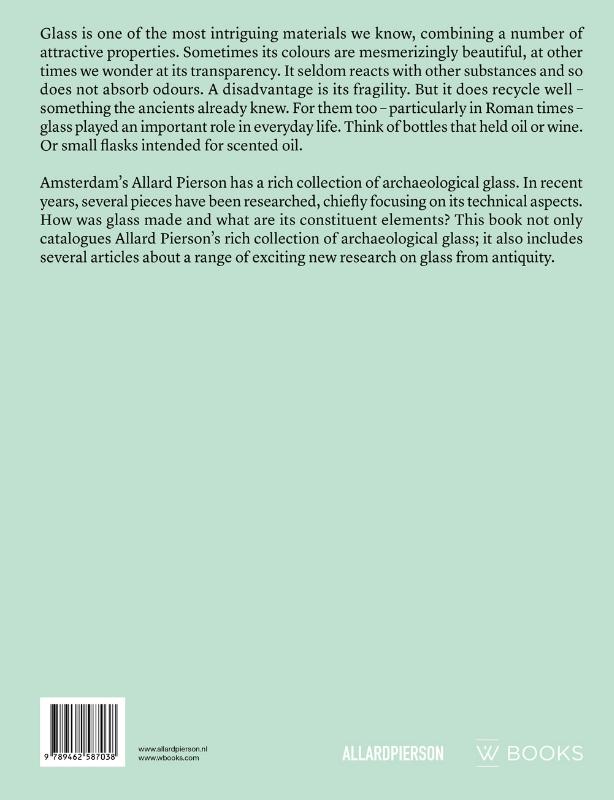
Glass, made in antiquity
Paperback256 pagina’sEngelsLeverbaar
Glass is one of the most intriguing materials we know, combining a number of attractive properties. Sometimes its colours are mesmerizingly beautiful, at other times we wonder at its transparency. It seldom reacts with other substances and so does not absorb odours. A disadvantage is its fragility. But it does recycle well -- something the ancients already knew (and put to good use?). For them too, - particularly in Roman times – glass played an important role in everyday life. Think of bottles that held oil or wine. Or small flasks intended for scented oil. Amsterdam's Allard Pierson has a rich collection of archaeological glass. In recent years, several pieces have been researched, chiefly focusing on its technical aspects. How was glass made and what are its constituent elements? This book not only catalogues Allard Pierson's rich collection of archaeological glass; it also includes several articles about a range of exciting new research on glass from antiquity. René van Beek (1958) studied classical archaeology at the University of Amsterdam. After his studies, he spent several years excavating in Turkey before becoming curator of the Classical World at the Allard Pierson Museum (Collections of the University of Amsterdam).There, he is mainly concerned with Roman culture and the museum’s collection of plaster casts after classical statues. As a glass lover and connoisseur of this fascinating material, he has spent the last few years intensively researching the museum’s ancient glass collectionGlass is one of the most intriguing materials we know, combining a number of attractive properties. Sometimes its colours are mesmerizingly beautiful, at other times we wonder at its transparency. It seldom reacts with other substances and so does not absorb odours. A disadvantage is its fragility. But it does recycle well -- something the ancients already knew (and put to good use?). For them too, - particularly in Roman times – glass played an important role in everyday life. Think of bottles that held oil or wine. Or small flasks intended for scented oil. Amsterdam's Allard Pierson has a rich collection of archaeological glass. In recent years, several pieces have been researched, chiefly focusing on its technical aspects. How was glass made and what are its constituent elements? This book not only catalogues Allard Pierson's rich collection of archaeological glass; it also includes several articles about a range of exciting new research on glass from antiquity. René van Beek (1958) studied classical archaeology at the University of Amsterdam. After his studies, he spent several years excavating in Turkey before becoming curator of the Classical World at the Allard Pierson Museum (Collections of the University of Amsterdam).There, he is mainly concerned with Roman culture and the museum’s collection of plaster casts after classical statues. As a glass lover and connoisseur of this fascinating material, he has spent the last few years intensively researching the museum’s ancient glass collection
In het kort
Bibliografisch
ISBN-139789462587038
Editie1
TaalEngels eng
Pagina’s256
GeïllustreerdJa
Uitgave
UitgeverUitgeverij WBOOKS
CB-relatie-id6509637
Verschenen16 mei 2025
StatusLeverbaar 04
BeschikbaarheidBeschikbaar 20
Adviesprijs (incl. btw)€ 34,95
Vorm & inhoud
ProductvormPaperback BC
SamenstellingLos product
Classificatie
NUR (hoofd)Toegepaste kunst 655
NUR (alle)655 Toegepaste kunst
Medewerkers
Auteur A01René van Beek
Herkomst
Werk-id (NSTC)501619095
MeldingBevestigd bij publicatie 03
Bijgewerkt6 augustus 2026
Lijkt op dit boek

Glass making in the greco-roman world

Islamic Glass in the Making
How things make history
Roman Pottery in the Low Countries
The Elemental Analysis of Glass Beads

Egypt beyond representation
Artefact Biographies from Mesolithic and Neolithic Europe and Beyond
Containers of Change
All About Plastic

Handheld XRF for art and archaeology
NSTC 501619095 · CB-relatie 6509637 · Bijgewerkt 6 augustus 2026