
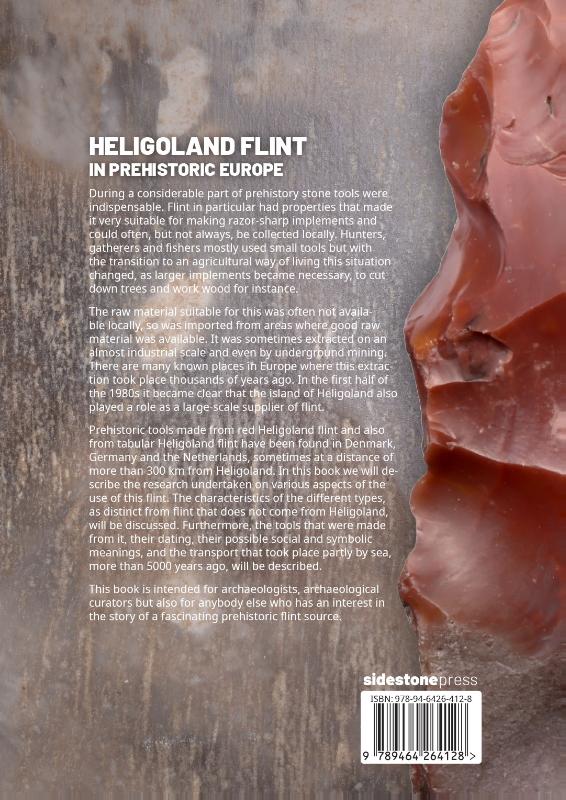
Heligoland Flint in Prehistoric Europe Characteristics, Typology, Distribution, Symbolism and Provenance
Hardback240 pagina’sEngels
Ook verkrijgbaar als
1 Introduction (Jaap Beuker)2 Research history (Jaap Beuker)3 Characteristics of different types of Heligoland flint in comparison with other northern Flint types (Jaap Beuker)3.1 Type 1 Red Heligoland flint3.1.1 Resemblances and differences between red Heligoland flint and patinated and burnt other flint types 3.2 Type 2 Yellow-brown Heligoland flint3.3 Type 3 Heligoland scar flint3.4 Type 4 Heligoland bone flint3.5 Type 5 Tabular Heligoland flint3.6 Other northern flint types3.6.1 Speckled Senonian flint and Scandinavian Senonian flint versus tabular Heligoland flint3.7 Scientific research4 Geology and occurrence of red Heligoland flint and tabular Heligoland flint (Jaap Beuker)4.1 Is red flint only found on Heligoland?4.2 Is tabular flint of the Heligoland type only found on Heligoland?4.3 Possible occurrence of Heligoland flint in glacial depositions5 Typology, dating and geographical distribution of artefacts from red Heligoland flint, tabular Heligoland flint and Heligoland scar flint5.1 Red Heligoland flint (Jaap Beuker and Erik Drenth)5.1.1 The Netherlands (Jaap Beuker and Erik Drenth)5.1.2 Germany (Martin Segschneider and Moritz Mennenga)5.1.3 Denmark (Klaus Hirsch)5.2. Tabular Heligoland flint and Heligoland scar flint (Jaap Beuker)5.2.1 Tabular Heligoland flint sickles5.2.2 Tabular Heligoland flint daggers5.2.3 Tabular Heligoland flint axes and chisels5.2.4 Tabular Heligoland flint blades5.2.5 Miscellanea5.2.6 Finds of artefacts of tabular Heligoland flint and Heligoland scar flint in Drenthe, Netherlands5.2.6.1 Tabular Heligoland flint artefacts5.2.6.2 Tabular Heligoland flint together with red Heligoland flint5.2.6.3 Artefacts of Heligoland scar flint5.2.7 Finds of tabular Heligoland flint artefacts in North Germany (Martin Segschneider and Moritz Mennenga)5.2.8 Finds of tabular Heligoland flint artefacts in Denmark (Klaus Hirsch)6 Extraction and knapping of Heligoland flint (Jaap Beuker)6.1 Artefact production and finds of flint artefacts on Heligoland6.2 Artefact production on the mainland6.2.1 Emmen, Netherlands, Drenthe6.2.2 Midlum, Germany, Lower Saxony7 Social and symbolic significance of Heligoland flint artefacts (Erik Drenth)7.1 Introductory remarks7.2 Red Heligoland flint: the question of colour and symbolic meaning7.3 The TRB West Group and the colour red7.4 Red Heligoland flint: its social meaning from the perspective of cultural and geographical distribution7.5 Conclusions8 Maritime transport and navigation (Martin Segschneider and Moritz Mennenga)9 Conclusions and final remarks, especially with regard to red Heligoland flint (Erik Drenth and Jaap Beuker)10 Catalogues of artefacts of red Heligoland flint and tabular Heligoland flint10.1 Catalogue of artefacts of red Heligoland flint in the Netherlands, Denmark and Germany (Jaap Beuker, Erik Drenth, Klaus Hirsch, Moritz Mennenga and Martin Segschneider)10.2 Catalogue of artefacts of tabular Heligoland flint in Drenthe, Netherlands (Jaap Beuker)10.3 Catalogue of artefacts of tabular Heligoland flint in Germany (Martin Segschneider and Moritz Mennenga)10.4 Catalogue of artefacts of tabular Heligoland flint in Denmark (Klaus Hirsch)LiteratureAppendix 1 Chronological schemes of the Netherlands, Germany and Denmark (Erik Drenth, Martin Segschneider and Klaus Hirsch)Appendix 2 Publications with information about the archaeology and geology of Heligoland flint (Jaap Beuker)Appendix 3 Typological remarks (Jaap Beuker and Erik Drenth)Image creditsAcknowledgementsDuring a considerable part of prehistory stone tools were indispensable. Flint in particular had properties that made it very suitable for making razor-sharp implements and could often, but not always, be collected locally. Hunters, gatherers and fishers mostly used small tools but with the transition to an agricultural way of living this situation changed, as larger implements became necessary, to cut down trees and work wood for instance. The raw material suitable for this was often not available locally, so was imported from areas where good raw material was available. It was sometimes extracted on an almost industrial scale and even by underground mining. There are many known places in Europe where this extraction took place thousands of years ago. In the first half of the 1980s it became clear that the island of Heligoland also played a role as a large-scale supplier of flint.Prehistoric tools made from red Heligoland flint and also from tabular Heligoland flint have been found in Denmark, Germany and the Netherlands, sometimes at a distance of more than 300 km from Heligoland. In this book we will describe the research undertaken on various aspects of the use of this flint. The characteristics of the different types, as distinct from flint that does not come from Heligoland, will be discussed. Furthermore, the tools that were made from it, their dating, their possible social and symbolic meanings, and the transport that took place partly by sea, more than 5000 years ago, will be described. This book is intended for archaeologists, archaeological curators but also for anybody else who has an interest in the story of a fascinating prehistoric flint source.
In het kort
ISBN-13
9789464264135
Uitgever
Verschenen
4 december 2025
Imprint
Bibliografisch
ISBN-139789464264135
Editie1
TaalEngels eng
Pagina’s240
GeïllustreerdJa
Uitgave
UitgeverSidestone Press
ImprintSidestone Press
CB-relatie-id9180064
Verschenen4 december 2025
StatusOnbekend 00
Vorm & inhoud
ProductvormHardback BB
SamenstellingLos product
Classificatie
NUR (hoofd)Archeologie 682
NUR (alle)682 Archeologie
Medewerkers
Auteur A01Jaap Beuker
Auteur A01Erik Drenth
Auteur A01Klaus Hirsch
Auteur A01Moritz Mennenga
Auteur A01Martin Segschneider
Herkomst
Werk-id (NSTC)501631563
MeldingBevestigd bij publicatie 03
Bijgewerkt6 augustus 2026
Lijkt op dit boek
Quarries and mines in social context
Living with Flint
Flintknapping from the Lateglacial to the Early Holocene
Prehension and hafting traces on flint tools
Hidden dimensions
Artefact Biographies from Mesolithic and Neolithic Europe and Beyond
The Life and Journey of Neolithic Copper Objects
Resurfacing the submerged past
Resurfacing the submerged past
The Lower to Middle Palaeolithic Transition in Northwestern Europe
NSTC 501631563 · CB-relatie 9180064 · Bijgewerkt 6 augustus 2026