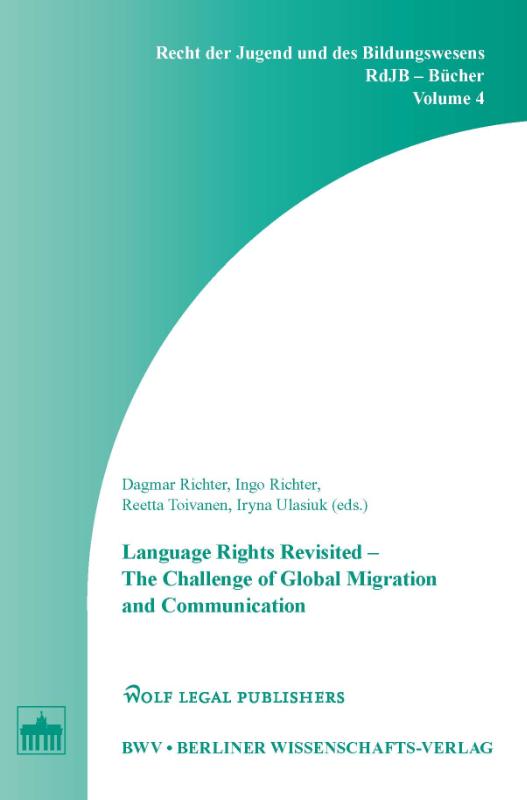
Language rights revisited - the challenge of global migration and communication
Paperback384 pagina’sEngels
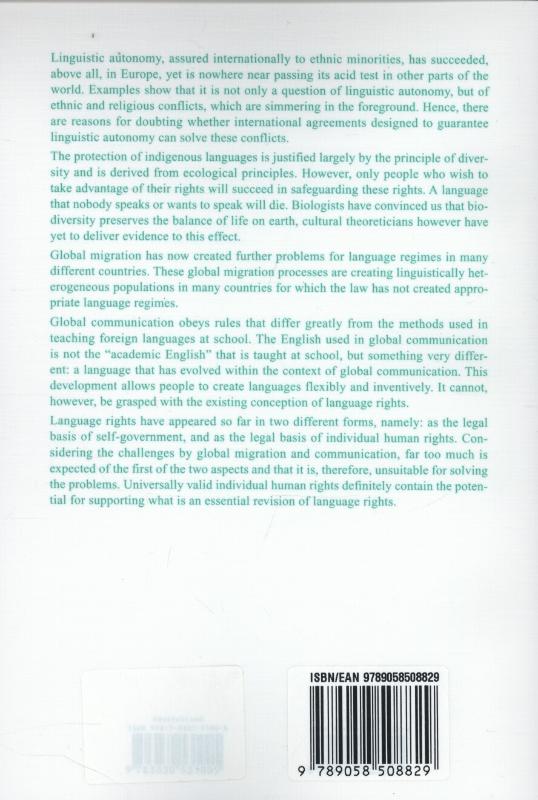
Linguistic autonomy, assured internationally to ethnic minorities, has succeeded, above all, in Europe, yet is nowhere near passing its acid test in other parts of the world. Examples show that it is not only a question of linguistic autonomy, but of ethnic and religious conflicts, which are simmering in the foreground. Hence, there are reasons for doubting whether international agreements designed to guarantee linguistic autonomy can solve these conflicts. The protection of indigenous languages is justified largely by the principle of diversity and is derived from ecological principles. However, only people who wish to take advantage of their rights will succeed in safeguarding these rights. A language that nobody speaks or wants to speak will die. Biologists have convinced us that biodiversity preserves the balance of life on earth, cultural theoreticians however have yet to deliver evidence to this effect. Global migration has now created further problems for language regimes in many different countries. These global migration processes are creating linguistically heterogeneous populations in many countries for which the law has not created appropriate language regimes. Global communication obeys rules that differ greatly from the methods used in teaching foreign languages at school. The English used in global communication is not the "academic English" that is taught at school, but something very different: a language that has evolved within the context of global communication. This development allows people to create languages flexibly and inventively. It cannot, however, be grasped with the existing conception of language rights. Language rights have appeared so far in two different forms, namely: as the legal basis of self-government, and as the legal basis of individual human rights. Considering the challenges by global migration and communication, far too much is expected of the first of the two aspects and that it is, therefore, unsuitable for solving the problems. Universally valid individual human rights definitely contain the potential for supporting what is an essential revision of language rights.
In het kort
ISBN-13
9789058508829
Uitgever
Verschenen
15 oktober 2012
Bibliografisch
ISBN-139789058508829
Editie1
TaalEngels eng
Pagina’s384
GeïllustreerdNee
Uitgave
Vorm & inhoud
ProductvormPaperback BC
SamenstellingLos product
Classificatie
NUR (hoofd)Internationaal (publiek)recht 828
NUR (alle)828 Internationaal (publiek)recht
Medewerkers
Redacteur B01Dagmar Richter
Redacteur B01Ingo Richter
Redacteur B01Reetta Toivanen
Redacteur B01Iryna Ulasiuk
Herkomst
Werk-id (NSTC)500274336
MeldingBevestigd bij publicatie 03
Bijgewerkt6 augustus 2026
Lijkt op dit boek
The Case of Congo: Are Basic Human Rights Merely a Thin Veneer for the Public?
Winx Club - Paniek op de toverschool
Volume III International and European Private Law
Volume I International and European Law
Volume II Comparative Public Law
Volume IV
Volume I-IV
Internationaal publiekrecht als wereldrecht
Cases and Materials European Union Law
Protecting the Public Interest in Times of Climate Change: From Abandoning Fossil Fuel to Sharing our Earth
NSTC 500274336 · CB-relatie 8037459 · Bijgewerkt 6 augustus 2026