
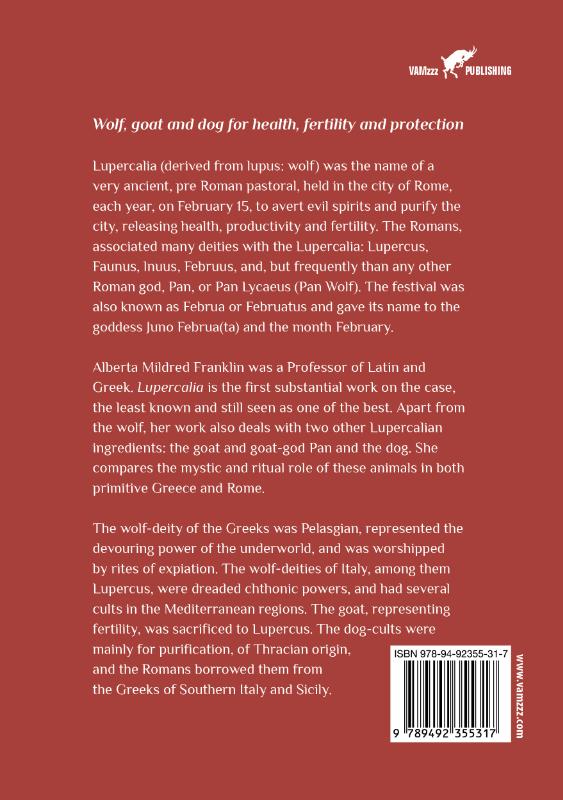
Lupercalia Rites and Mysteries of Wolf Worship
Paperback162 pagina’sEngels
CHAPTER IIntroduction — 9New knowledge about the religion of the Mediterranean race offers a new basis for a study of the Lupercalia. The characteristic deity of the Mediterranean race was an earth-goddess, incarnate in all natural objects, the giver of life and of death, and worshipped by orgiastic rites. The characteristic deity of the Aryans was a sky-god, who was honored by a calm, rationalistic ceremonial.CHAPTER II The Ceremonial of The Lupercalia — 29The ceremonial rites of the Lupercalia were complex and seemingly incoherent. The Romans had vague ideas about the presiding god, but regarded the purpose of the festival as (a) protection from evil, (b) productivity, and (c) purification.CHAPTER IIIThe Wolf-Deity in Greece — 33The wolf-deity of the Greeks was Pelasgian; he represented the devouring power of the underworld, and was worshipped by rites of expiation.CHAPTER IVThe Wolf-Deity in Italy — 45The wolf-deities of Italy, among them Lupercus, were also dreaded chthonic powers, and had cults of the Mediterranean type. The Lupercalia originated among the Ligurians, and at first consisted of the sacrifice of a goat to Lupercus, a ceremonial tasting of the entrails, an expiatory flight by the priests, and a feast. It was an apotropaic ceremony designed to ward offevil.CHAPTER VThe Sacred Goat in Greece — 73The goat-god of the Greeks was a Pelasgian fertility god. His fertilizing power was often appropriated by anthropomorphic gods.CHAPTER VIThe Sacred Goat in Italy — 81In Italy the goat-god was also the giver of fertility, and originated among the Ligurians. Juno was closely associated with the goat, and some of her fertility rites were added by the Romans to the Lupercalia: the Luperci girded themselves with goat-skins and, as they ran about the Palatine, struck the women with goat-skin thongs as a fertility charm. Henceforth the gift of fertility was one of the important purposes of the Lupercalia.CHAPTER VII The Dog as Sacred Animal in Greece — 103The dog-cults in Greece were Pelasgian, mainly of Thracian origin; and had especial potency for purification.CHAPTER VIIIThe Dog as a Sacred Animal in Italy — 113The dog-cults of the Italians seem to have been borrowed from the Greeks of Southern Italy and Sicily. The Sabines, who adopted many Mediterranean customs, who were familiar with the purificatory power of the dog, and who exerted a powerful influence over the religion of Rome, probably added the sacrifice of a dog to the Lupercalia. Thus purification came to be an important element of the Lupercalia.CHAPTER IXThe Blood-Ceremony of The Lupercalia — 125The blood-ceremonial of the Lupercalia finds no parallel in Roman cults, but is similar to certain rites of the Orphics which sought to assure complete union with the deity. It is probable that these Orphic elements were added to the Lupercalia during the war with Hannibal, or the years immediately following, when many orgiastic cults of the Greeks were brought into Rome. Thus the Lupercalia was spiritualized by new rites of cleansing and by the assurance of kinship with the deity.CHAPTER XResume — 143In its development the Lupercalia reflected the development of the Roman people.Bibliography — 147Post ScriptumLupercalia was the name of a very ancient, pre Roman pastoral, held in Rome each year on February 15, to avert evil spirits and purify the city, releasing health, productivity and fertility.Lupercalia (derived from lupus: wolf) was the name of a very ancient, pre Roman pastoral, held in the city of Rome, each year, on February 15, to avert evil spirits and purify the city, releasing health, productivity and fertility. The Romans, associated many deities with the Lupercalia: Lupercus, Faunus, lnuus, Februus, and, but frequently than any other Roman god, Pan, or Pan Lycaeus (Pan Wolf). The festival was also known as Februa or Februatus and gave its name to the goddess Juno Februa(ta) and the month February. Alberta Mildred Franklin was a Professor of Latin and Greek. Lupercalia is the first substantial work on the case, the least known and still seen as one of the best. Apart from the wolf, her work also deals with two other Lupercalian ingredients: the goat and goat-god Pan and the dog. She compares the mystic and ritual role of these animals in both primitive Greece and Rome.The wolf-deity of the Greeks was Pelasgian, represented the devouring power of the underworld, and was worshipped by rites of expiation. The wolf-deities of Italy, among them Lupercus, were dreaded chthonic powers, and had several cults in the Mediterranean regions. The goat, representing fertility, was sacrificed to Lupercus. The dog-cults were mainly for purification, of Thracian origin, and the Romans borrowed them from the Greeks of Southern Italy and Sicily.
In het kort
ISBN-13
9789492355317
Uitgever
Verschenen
24 november 2017
Imprint
Bibliografisch
ISBN-139789492355317
Editie1
TaalEngels eng
Pagina’s162
GeïllustreerdJa
Uitgave
UitgeverVAMzzz Publishing
ImprintVAMzzz Publishing
CB-relatie-id6391696
Verschenen24 november 2017
StatusOnbekend 00
BeschikbaarheidContact leverancier 99
Adviesprijs (incl. btw)€ 19,50
Vorm & inhoud
ProductvormPaperback BC
SamenstellingLos product
Classificatie
NUR (hoofd)Occultisme 725
NUR (alle)725 Occultisme
Medewerkers
Auteur A01Alberta Mildred Franklin
Herkomst
Werk-id (NSTC)500367848
MeldingBevestigd bij publicatie 03
Bijgewerkt6 augustus 2026
Lijkt op dit boek







NSTC 500367848 · CB-relatie 6391696 · Bijgewerkt 6 augustus 2026