
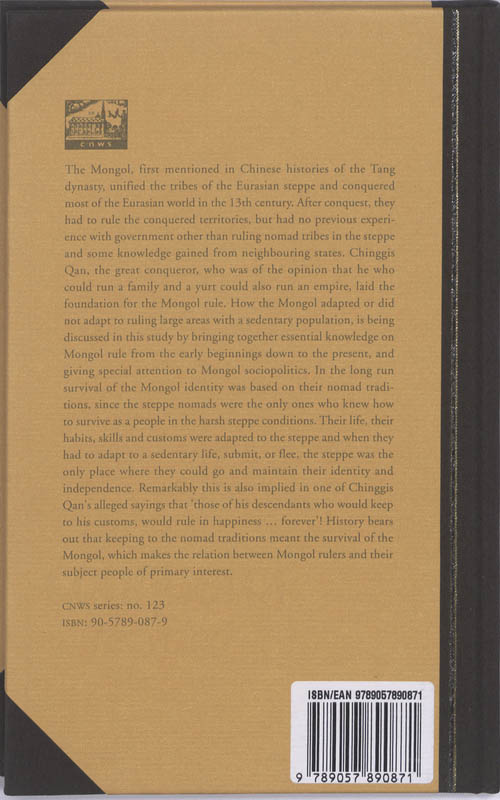
Mongol rule reflections on Mongol sociopolitics
The Mongol, first mentioned in Chinese histories of the Tang dynasty, unified the tribes of the Eurasian steppe and conquered most of the Eurasian world in the 13th century. After conquest, they had to rule the conquered territories, but had no previous experience with government other than ruling nomad tribes in the steppe and some knowledge gained from neighbouring states. Chinggis Qan, the great conqueror, who was of the opinion that he who could run a family and a yurt could also run an empire, laid the foundation for the Mongol rule. How the Mongol adapted or did not adapt to ruling large areas with a sedentary population, is being discussed in this study by bringing together essential knowledge on Mongol rule from the early beginnings down to the present, and giving special attention to Mongol sociopolitics. In the long run survival of the Mongol identity was based on their nomad traditions, since the steppe nomads were the only ones who knew how to survive as a people in the harsh steppe conditions. Their life, their habits, skills and customs were adapted to the steppe and when they had to adapt to a sedentary life, submit, or flee, the steppe was the only place where they could go and maintain their identity and independence. Remarkably this is also implied in one of Chinggis Qan's alleged sayings that 'those of his descendants who would keep to his customs, would rule in happiness forever'! History bears out that keeping to the nomad traditions meant the survival of the Mongol, which makes the relation between Mongol rulers and their subject people of primary interest.
In het kort
ISBN-13
9789057890871
Uitgever
Verschenen
1 juli 2003
Bibliografisch
ISBN-139789057890871
SerieCNWS publications — deel 123
Editie1
TaalNederlands dut
Pagina’s85
GeïllustreerdJa
Uitgave
UitgeverCnws Publicaties
CB-relatie-id8767404
Verschenen1 juli 2003
StatusOnbekend 00
BeschikbaarheidContact leverancier 99
Zonder prijsPrijs volgt
Vorm & inhoud
ProductvormHardback BB
SamenstellingLos product
Classificatie
Medewerkers
Auteur A01D. Eisma
Herkomst
Werk-id (NSTC)500700913
MeldingBevestigd bij publicatie 03
Bijgewerkt6 augustus 2026
Lijkt op dit boek





NSTC 500700913 · CB-relatie 8767404 · Bijgewerkt 6 augustus 2026