
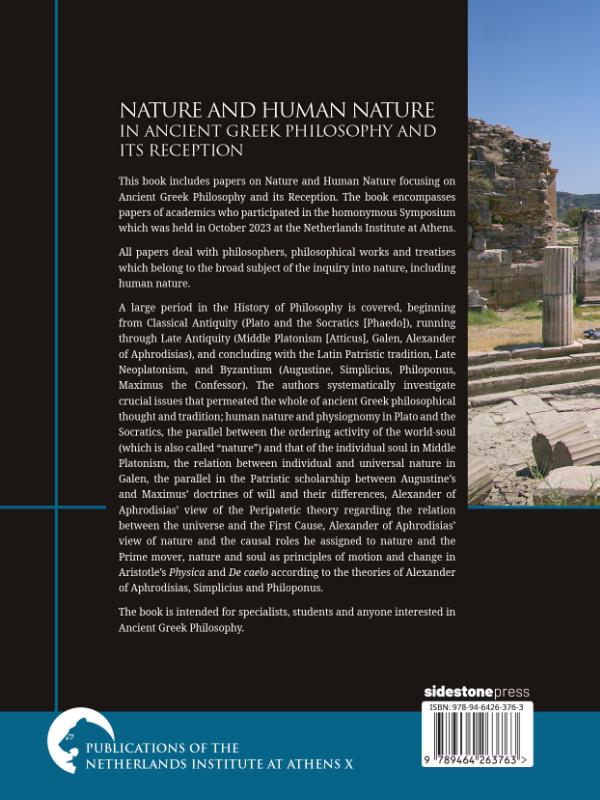
Nature and Human Nature in Ancient Greek Philosophy and Its Reception
IntroductionMelina G. MouzalaPhaedo of Elis, Physiognomy, and Human Nature in Plato’s PhaedoClaudia MarsicoOrdering the Soul: ethical and cosmological perspectives on Atticus’ doctrine of providenceAlexandra MichalewskiGalen on Human Nature: Individual and CosmosTeun TielemanNature and Will in Maximus the Confessor and AugustineFr. Nikolaos LoudovikosAlexander of Aphrodisias on the first cause, divine power, the city and the householdFrans de HaasNature in Alexander of Aphrodisias’ Commentary on Book II of the PhysicsIstván BodnárNature and Soul as Principles of Motion and Change: Simplicius, Alexander of Aphrodisias, and Philoponus on Aristotle’s Physics II. 1-3Melina G. MouzalaThis book includes papers on Nature and Human Nature focusing on Ancient Greek Philosophy and its Reception. The book encompasses papers of academics who participated in the homonymous Symposium which was held in October 2023 at the Netherlands Institute at Athens.All papers deal with philosophers, philosophical works and treatises which belong to the broad subject of the inquiry into nature, including human nature.A large period in the History of Philosophy is covered, beginning from Classical Antiquity (Plato and the Socratics [Phaedo]), running through Late Antiquity (Middle Platonism [Atticus], Galen, Alexander of Aphrodisias), and concluding with the Latin Patristic tradition, Late Neoplatonism, and Byzantium (Augustine, Simplicius, Philoponus, Maximus the Confessor). The authors systematically investigate crucial issues that permeated the whole of ancient Greek philosophical thought and tradition; human nature and physiognomy in Plato and the Socratics, the parallel between the ordering activity of the world-soul (which is also called “nature”) and that of the individual soul in Middle Platonism, the relation between individual and universal nature in Galen, the parallel in the Patristic scholarship between Augustine’s and Maximus’ doctrines of will and their differences, Alexander of Aphrodisias’ view of the Peripatetic theory regarding the relation between the universe and the First Cause, Alexander of Aphrodisias’ view of nature and the causal roles he assigned to nature and the Prime mover, nature and soul as principles of motion and change in Aristotle’s Physica and De caelo according to the theories of Alexander of Aphrodisias, Simplicius and Philoponus.The book is intended for specialists, students and anyone interested in Ancient Greek Philosophy.
In het kort
ISBN-13
9789464263763
Uitgever
Verschenen
15 oktober 2025
Imprint
Bibliografisch
ISBN-139789464263763
SeriePublications of the Netherlands Institute at Athens — deel X
Editie1
TaalEngels eng
Pagina’s136
GeïllustreerdNee
Uitgave
UitgeverSidestone Press
ImprintSidestone Press
CB-relatie-id9180064
Verschenen15 oktober 2025
StatusOnbekend 00
Vorm & inhoud
ProductvormPaperback BC
SamenstellingLos product
Classificatie
NUR (hoofd)Geschiedenis van de filosofie 732
NUR (alle)732 Geschiedenis van de filosofie
Medewerkers
Bewerker B05Melina Mouzala
Herkomst
Werk-id (NSTC)501626558
MeldingBevestigd bij publicatie 03
Bijgewerkt6 augustus 2026
Lijkt op dit boek

Geletterde geesten - tweede editie
Petri Thomae Quaestiones de formis
Petri Thomae Quaestiones de formis
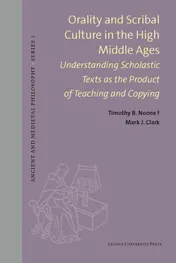
Orality and Scribal Culture in the High Middle Ages
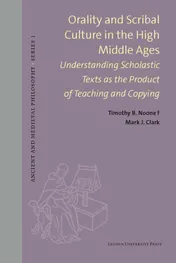
Orality and Scribal Culture in the High Middle Ages
Orality and Scribal Culture in the High Middle Ages

Het verhaal van de filosofie: de Oudheid

Summa (Quaestiones ordinariae) art. LXXIII - LXXV

Summa (Quaestiones ordinariae) art. LXXIII - LXXV

Plutarch’s 'Politikos'
NSTC 501626558 · CB-relatie 9180064 · Bijgewerkt 6 augustus 2026