
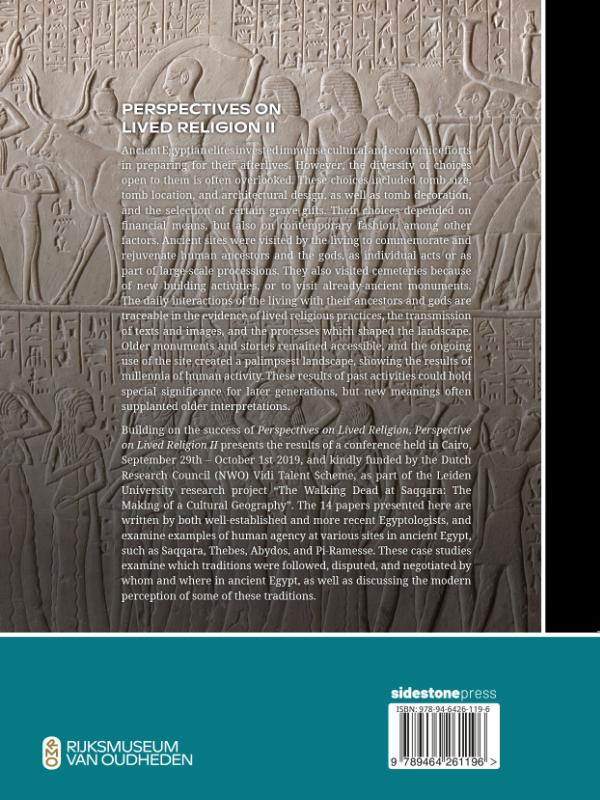
Perspectives on Lived Religion II The Making of a Cultural Geography
PART I. Religious PracticesTaking the dead to the cemetery, communicating with them, and managing their presenceJohn Baines (University of Oxford)‘Socializing’ the sacred space. An analysis of graffiti and appeals to the living as social acts in KarnakChiara Salvador (University of Oxford)Figurations in the study of Egyptian religion. The case of AmarnaJanne Arp (Georg-August Universität Göttingen)PART II. TransmissionRemembering Forward. On the Transmission of pictorial representations in non–royal tomb decoration up to the New KingdomGabriele Pieke (Reiss–Engelhorn–Museen, Mannheim)Establishing communication channels. Remarks on the transmission of the Ritual of Opening the Mouth as (not only) a funerary textJoachim Quack (University of Heidelberg)The Flying DeadFaiza HaikalPART III. LANDSCAPEPyramid life in secondary epigraphy. Cultural biography and regimes of historicityHana Navratilova (University of Reading)The Landscape(s) of Pi-Ramesse. Living and Dying in the Capital of Ramesside EgyptHenning Franzmeier (Roemer- und Pelizaeus-Museum Hildesheim)Between Town and Temple. Exploring the Influences of Royal, Religious and Social Institutions on Funerary Landscape at South Abydos during the New KingdomKevin Cahail (University of Pennsylvania Museum of Archaeology and Anthropology)Ancient Egyptian elites invested immense cultural and economic efforts in preparing for their afterlives. However, the diversity of choices open to them is often overlooked. These choices included tomb size, tomb location, and architectural design, as well as tomb decoration, and the selection of certain grave gifts. Their choices depended on financial means, but also on contemporary fashion, among other factors. Ancient sites were visited by the living to commemorate and rejuvenate human ancestors and the gods, as individual acts or as part of large-scale processions. They also visited cemeteries because of new building activities, or to visit already-ancient monuments. The daily interactions of the living with their ancestors and gods are traceable in the evidence of lived religious practices, the transmission of texts and images, and the processes which shaped the landscape. Older monuments and stories remained accessible, and the ongoing use of the site created a palimpsest landscape, showing the results of millennia of human activity. These results of past activities could hold special significance for later generations, but new meanings often supplanted older interpretations.Building on the success of Perspectives on Lived Religion, Perspective on Lived Religion II presents the results of a conference held in Cairo, September 29th – October 1st 2019, and kindly funded by the Dutch Research Council (NWO) Vidi Talent Scheme, as part of the Leiden University research project “The Walking Dead at Saqqara: The Making of a Cultural Geography”. The papers presented here are written by both well-established and more recent Egyptologists, and examine examples of human agency at various sites in ancient Egypt, such as Saqqara, Thebes, Abydos, and Pi-Ramesse. These case studies examine which traditions were followed, disputed, and negotiated by whom and where in ancient Egypt, as well as discussing the modern perception of some of these traditions.
In het kort
ISBN-13
9789464261202
Uitgever
Verschenen
6 oktober 2022
Serie
Imprint
Bibliografisch
Uitgave
UitgeverSidestone Press
ImprintSidestone Press
CB-relatie-id9180064
Verschenen6 oktober 2022
StatusOnbekend 00
Vorm & inhoud
ProductvormHardback BB
SamenstellingLos product
Classificatie
NUR (hoofd)Archeologie 682
NUR (alle)682 Archeologie
Medewerkers
Herkomst
Werk-id (NSTC)501505169
MeldingBevestigd bij publicatie 03
Bijgewerkt6 augustus 2026
Lijkt op dit boek
NSTC 501505169 · CB-relatie 9180064 · Bijgewerkt 6 augustus 2026