
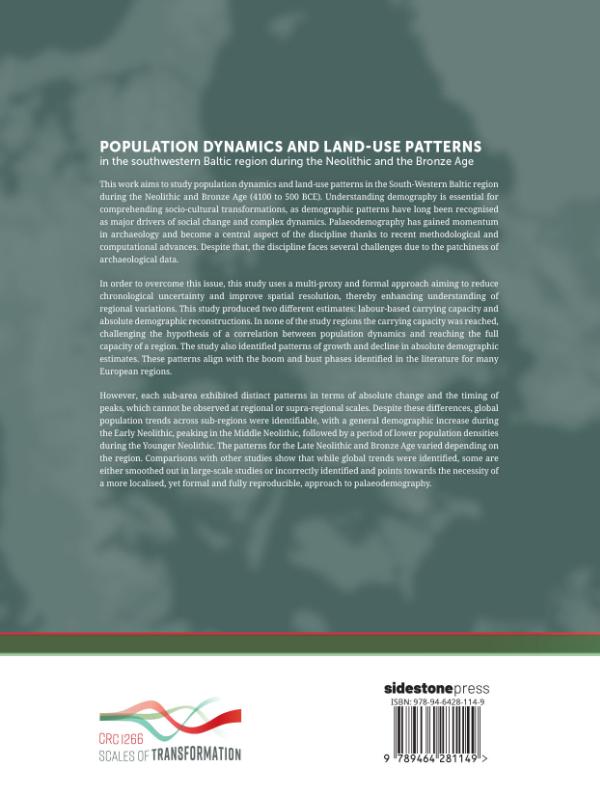
Population dynamics and land-use patterns in the southwestern Baltic region during the Neolithic and the Bronze Age
Ook verkrijgbaar als
Preface of the series editorsPreface of the author1 Introduction1.1 Study region1.1.1 Coordinates and reference systems1.1.2 Landscape and geomorphology1.2 Technical requirements2 State of the archaeological research in the region2.1 Chronology2.1.1 The Funnel Beaker Group: Early and Middle Neolithic2.1.1.1 The Early and Middle Neolithic landscape2.1.1.2 Settlements and houses during the TRB2.1.1.3 Burial practices during the TRB2.1.2 Young Neolithic2.1.3 Late Neolithic2.1.3.1 Late Neolithic settlement structure2.1.3.2 Late Neolithic funerary practice2.1.4 Bronze Age2.1.4.1 Metal economy and social organisation2.1.4.2 Barrow construction and demographic estimates3 Data3.1 Archaeological data3.1.1 Germany3.1.1.1 Mecklenburg – Western Pomerania3.1.1.2 Schleswig-Holstein3.1.2 Sweden3.1.2.1 Site typologies3.1.3 Denmark3.1.4 Case study selection3.2 Radiocarbon data3.3 Environmental data3.3.1 Elevation and distance-based variables3.3.2 Soil and geological data4 Demography4.1 State of the art in Palaeodemography4.1.1 Radiocarbon dating4.1.2 Demographic fluctuations in northern Germany and southern Scandinavia4.2 Household size4.2.1 House size variation in the study area4.2.2 House duration4.3 Case studies4.3.1 Saxån-Ålabäcken valley, western Scania4.3.1.1 The Early Neolithic4.3.1.2 Early Neolithic II – Middle Neolithic II4.3.1.3 Middle Neolithic III – V4.3.1.4 Demographic estimates4.3.2 Hyllie area4.3.2.1 Almhov4.3.2.2 The other settlements4.3.3 Thy4.3.3.1 Bjerre Enge4.3.3.2 Aas4.3.4 Cumulative results5 Methods5.1 Chronological Modelling5.1.1 Radiocarbon calibration5.1.2 Summed Probability Distribution5.1.3 Kernel Density Estimation5.2 Point Pattern Analysis5.2.1 Spatial intensity and Kernel Density Estimation5.2.2 First-Order properties5.2.2.1 Rhohat5.2.2.2 Point Process Models5.2.3 Second-order properties5.3 Cluster Analysis5.3.1 Cluster analysis in archaeology5.3.2 Clustering algorithms5.3.2.1 Square Error Clustering5.3.2.2 Density based clustering5.3.2.3 Model-based clustering6 Results6.1 Chronological Modelling6.2 Point Pattern Analysis6.2.1 Point Process Models6.2.1.1 Bornholm6.2.1.2 Northwestern Zealand6.2.1.3 Thy6.2.1.4 Central Jutland6.2.1.5 East Holstein6.3 Cluster Analysis6.3.1 Bornholm6.3.2 Northwestern Zealand6.3.3 Thy6.3.4 Central Jutland6.3.5 East Holstein6.3.6 Rügen6.3.7 Southeastern Schleswig (Dänischer Wohld)6.3.8 Southwestern Scania6.3.9 Western Scania6.3.10 Bjäre peninsula and Northeastern Scania6.4 Demographic model6.4.1 Carrying capacity estimation6.4.2 Absolute estimates7 Discussion7.1 How many?7.2 Comparison7.2.1 Relative demographic reconstructions7.2.2 Absolute demographic reconstructions7.3 Modelling considerations8 ConclusionsReferencesAcknowledgementsThis work aims to study population dynamics and land-use patterns in the South-Western Baltic region during the Neolithic and Bronze Age (4100 to 500 BCE). Understanding demography is essential for comprehending socio-cultural transformations, as demographic patterns have long been recognised as major drivers of social change and complex dynamics. Palaeodemography has gained momentum in archaeology and become a central aspect of the discipline thanks to recent methodological and computational advances. Despite that, the discipline faces several challenges due to the patchiness of archaeological data. In order to overcome this issue, this study uses a multi-proxy and formal approach aiming to reduce chronological uncertainty and improve spatial resolution, thereby enhancing understanding of regional variations. This study produced two different estimates: labour-based carrying capacity and absolute demographic reconstructions. In none of the study regions the carrying capacity was reached, challenging the hypothesis of a correlation between population dynamics and reaching the full capacity of a region. The study also identified patterns of growth and decline in absolute demographic estimates. These patterns align with the boom and bust phases identified in the literature for many European regions. However, each sub-area exhibited distinct patterns in terms of absolute change and the timing of peaks, which cannot be observed at regional or supra-regional scales. Despite these differences, global population trends across sub-regions were identifiable, with a general demographic increase during the Early Neolithic, peaking in the Middle Neolithic, followed by a period of lower population densities during the Younger Neolithic. The patterns for the Late Neolithic and Bronze Age varied depending on the region. Comparisons with other studies show that while global trends were identified, some are either smoothed out in large-scale studies or incorrectly identified and points towards the necessity of a more localised, yet formal and fully reproducible, approach to palaeodemography.
In het kort
ISBN-13
9789464281149
Uitgever
Verschenen
26 maart 2026
Bibliografisch
ISBN-139789464281149
SerieScales of Transformation — deel 23
Editie1
TaalEngels eng
Pagina’s200
GeïllustreerdJa
Uitgave
Vorm & inhoud
ProductvormPaperback BC
SamenstellingLos product
Classificatie
NUR (hoofd)Archeologie 682
NUR (alle)682 Archeologie
Medewerkers
Auteur A01Giacomo Bilotti
Herkomst
Werk-id (NSTC)501636790
MeldingBevestigd bij publicatie 03
Bijgewerkt6 augustus 2026
Lijkt op dit boek
Beyond heterogeneities
Complexity and dynamics
The Development of Social Inequality in the Carpathian Basin between 5200 and 1000 BCE
Separation, hybridisation, and networks
Archaeology in the Žitava valley II
Death in Times of Change
Wild West Frisia
Quarries and mines in social context

The eve of destruction?

Shaping Cultural Landscapes
NSTC 501636790 · CB-relatie 9180064 · Bijgewerkt 6 augustus 2026