
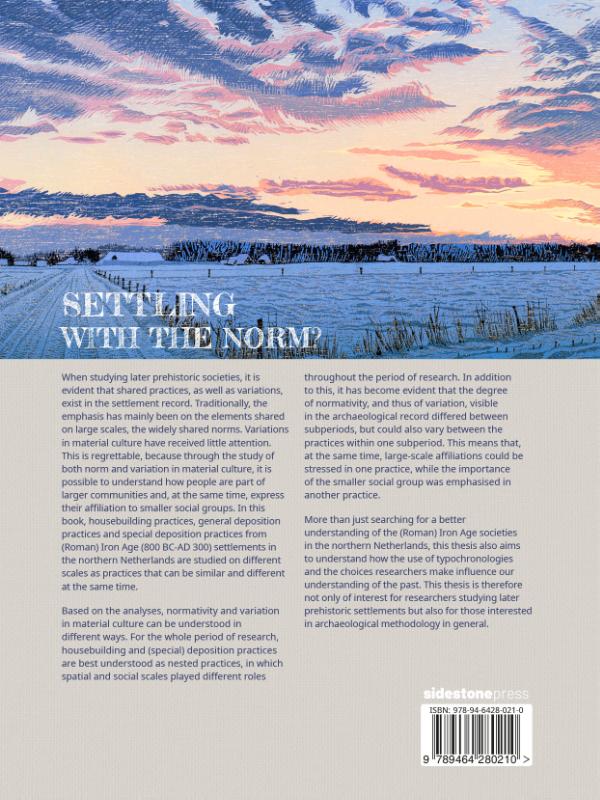
Settling with the norm? Norm and variation in social groups and their material manifestations in (Roman) Iron Age (800 BC–AD 300) settlement sites of the northern Netherlands
Paperback288 pagina’sEngels
Ook verkrijgbaar als
1. Introduction2. Theoretical framework3. Housebuilding traditions on the Fries-Drents plateau4. Deposition practices on later prehistoric settlement sites5. Special deposition practices6. ConclusionReferencesAppendix 1: Overview of (Roman) Iron Age sites on the Fries-Drents plateauAppendix 2: Overview of house plans per periodAppendix 3: Overview of radiocarbon datesAppendix 4: Co-occurrences between characteristicsAppendix 5: Description of pits discussed in chapter 5Appendix 6: Overview of location of pits discussed in chapter 5Appendix 7: Overview of characteristics of pits discussed in chapter 5Dutch summary / Nederlandse samenvattingAcknowledgementsCurriculum VitaeWhen studying later prehistoric societies, it is evident that shared practices, as well as variations, exist in the settlement record. Traditionally, the emphasis has mainly been on the elements shared on large scales, the widely shared norms. Variations in material culture have received little attention. This is regrettable, because through the study of both norm and variation in material culture, it is possible to understand how people are part of larger communities and, at the same time, express their affiliation to smaller social groups. In this book, housebuilding practices, general deposition practices and special deposition practices from (Roman) Iron Age (800 BC-AD 300) settlements in the northern Netherlands are studied on different scales as practices that can be similar and different at the same time.Based on the analyses, normativity and variation in material culture can be understood in different ways. For the whole period of research, housebuilding and (special) deposition practices are best understood as nested practices, in which spatial and social scales played different roles throughout the period of research. In addition to this, it has become evident that the degree of normativity, and thus of variation, visible in the archaeological record differed between subperiods, but could also vary between the practices within one subperiod. This means that, at the same time, large-scale affiliations could be stressed in one practice, while the importance of the smaller social group was emphasised in another practice.More than just searching for a better understanding of the (Roman) Iron Age societies in the northern Netherlands, this thesis also aims to understand how the use of typochronologies and the choices researchers make influence our understanding of the past. This thesis is therefore not only of interest for researchers studying later prehistoric settlements but also for those interested in archaeological methodology in general.
In het kort
ISBN-13
9789464280210
Uitgever
Verschenen
15 november 2021
Bibliografisch
ISBN-139789464280210
Editie1
TaalEngels eng
Pagina’s288
GeïllustreerdJa
Uitgave
Vorm & inhoud
ProductvormPaperback BC
SamenstellingLos product
Classificatie
NUR (hoofd)Archeologie 682
NUR (alle)682 Archeologie
Medewerkers
Auteur A01Karen de Vries
Herkomst
Werk-id (NSTC)501474947
MeldingBevestigd bij publicatie 03
Bijgewerkt6 augustus 2026
Lijkt op dit boek
A completely normal practice
Complexity and dynamics
Beyond heterogeneities

Before Temples
The Development of Social Inequality in the Carpathian Basin between 5200 and 1000 BCE

The early Neolithic of Northern Europe

Between variability and singularity

Serial Learners
A Social Archaeology of Kinship in Iberia and Beyond
Cremation in the Early Middle Ages
NSTC 501474947 · CB-relatie 9180064 · Bijgewerkt 6 augustus 2026