
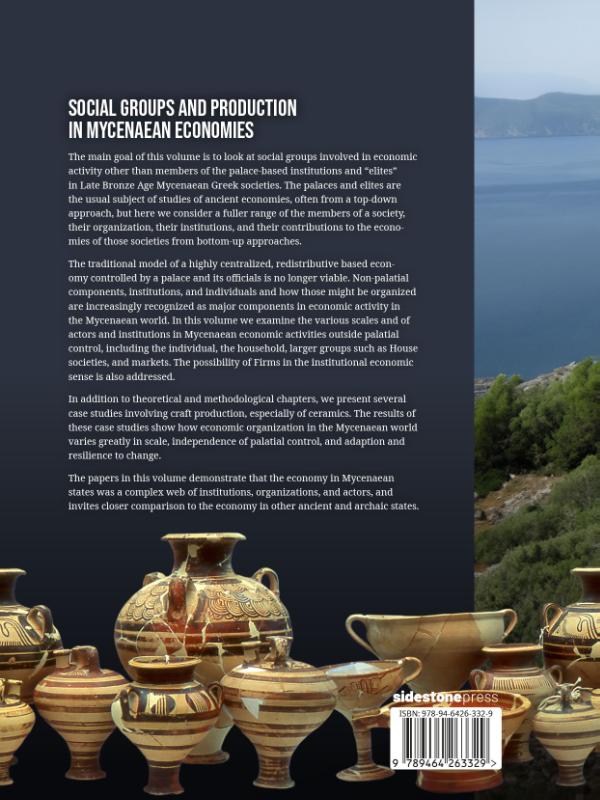
Social Groups and Production in Mycenaean Economies Papers from the Langford Conference, Florida State University, Tallahassee, 24-25 February 2023
Hardback170 pagina’sEngels
Getting beyond elite versus non-elite in Mycenaean economiesDaniel J. PullenReading Between the Lines: Textual Evidence for Socioeconomic Organization in the Late Bronze AgeDimitri NakassisA House Divided? Social Structure Before, During and After the Mycenaean Administration at KnossosJan DriessenNot a Great Kingdom: Mycenaean Economic Variation as a Measure of NonintegrationMichael L. Galaty and William A. ParkinsonMycenaean Economic Institutions: A Firm’s Eye ViewSarah C. MurrayCoastal Communities and Connectivity in the Late Bronze Age AegeanThomas F. TartaronBrokering Change in Southern Aegean Networks: A Comparison of Communities of Practice in the Cyclades and Mainland Greece in the Era of MinoanizationNatalie AbellPetsas House: Potters, The Workshop, and Ceramic Production in Mycenae’s Society and EconomyKim SheltonPotting Communities during the Mycenaean Palatial PeriodPeter M. Day and Eleftheria KardamakiThe main goal of this volume is to look at social groups involved in economic activity other than members of the palace-based institutions and “elites” in Late Bronze Age Mycenaean Greek societies. The palaces and elites are the usual subject of studies of ancient economies, often from a top-down approach, but here we consider a fuller range of the members of a society, their organization, their institutions, and their contributions to the economies of those societies from bottom-up approaches. The traditional model of a highly centralized, redistributive based economy controlled by a palace and its officials is no longer viable. Non-palatial components, institutions, and individuals and how those might be organized are increasingly recognized as major components in economic activity in the Mycenaean world. In this volume we examine the various scales and of actors and institutions in Mycenaean economic activities outside palatial control, including the individual, the household, larger groups such as House societies, and markets. The possibility of Firms in the institutional economic sense is also addressed.In addition to theoretical and methodological chapters, we present several case studies involving craft production, especially of ceramics. The results of these case studies show how economic organization in the Mycenaean world varies greatly in scale, independence of palatial control, and adaption and resilience to change.The papers in this volume demonstrate that the economy in Mycenaean states was a complex web of institutions, organizations, and actors, and invites closer comparison to the economy in other ancient and archaic states.
In het kort
ISBN-13
9789464263336
Uitgever
Verschenen
20 maart 2025
Imprint
Bibliografisch
ISBN-139789464263336
Editie1
TaalEngels eng
Pagina’s170
GeïllustreerdJa
Uitgave
UitgeverSidestone Press
ImprintSidestone Press
CB-relatie-id9180064
Verschenen20 maart 2025
StatusOnbekend 00
Vorm & inhoud
ProductvormHardback BB
SamenstellingLos product
Classificatie
NUR (hoofd)Archeologie 682
NUR (alle)682 Archeologie
Medewerkers
Bewerker B05Daniel Pullen
Herkomst
Werk-id (NSTC)501602850
MeldingBevestigd bij publicatie 03
Bijgewerkt6 augustus 2026
Lijkt op dit boek
Labouring with large stones

Towards the Borders of the Bronze Age and Beyond
Middle and Late Helladic Laconia
Shaping Cultural Landscapes

Farmers’ trade and markets
Archaeological Approaches to Inequality, Political Organisation, and Social Complexity
Identity, Power and Group Formation in Archaic Macedonia (600-400 BC)
Household goods in the European Medieval and Early Modern Countryside
Fields, Sherds and Scholars
A Social Archaeology of Kinship in Iberia and Beyond
NSTC 501602850 · CB-relatie 9180064 · Bijgewerkt 6 augustus 2026