
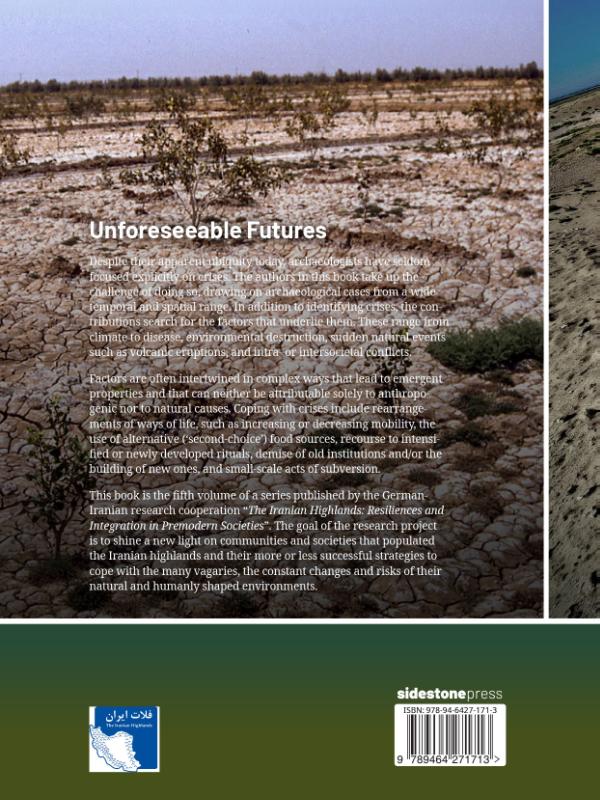
Unforeseeable Futures Confronting Crises in the Archaeology of Highland Societies
Paperback220 pagina’sEngels
Crises – An IntroductionReinhard Bernbeck, Susan Pollock, and Martin KehlCharacterising crisesCrises of Our Own Making: Finding a Way Out of the Resilience Myth for ArchaeologyMatthew C. ReillyAre Archaeologists Crisis-philic? Exploring the Nexus of Climate Change and MigrationSepideh MaziarPolitics, religion, and crisesHow did the Elamites Cope with Crises? Looking at the Gap between the Middle and the Neo-Elamite PeriodRafiei-AlaviIs This Burning an Eternal Flame? Political Crises and Dynastic Cults in Southwest Asia during Early AntiquityMichael BrownDeath at the beginning of life. Medieval and early modern infant burial as response to multiple crises and what we can learn from it todayBarbara HausmairEnvironment and CrisesClimate and Crises: Towards an Eventful and Punctuated PrehistoryFelix RiedeDehqaed’s Natural Crises and the Challenge of FloodingZohreh ZehbariFending off Crises with Porosity: Sand, Water and Wind in the Helmand BasinMoslem Mishmastnehi and Reinhard BernbeckResources, technology, and crisisProbing Criticality: Sliding Scales of Crisis in Two Highland SocietiesReinhard Bernbeck, Susan Pollock, and Jana EgerOn the Edge of Crisis – A View from ArchaeometryKristina A FrankeMetal and Crisis: Crisis Phenomena in the Production, Distribution and Utilisation of Copper and Other Metals Between the 4th and the Late 2nd Millennium BCE in West AsiaThomas StöllnerNo Risk, No NeolithisationJudith Thomalsky and Akbar AbediDespite their apparent ubiquity today, archaeologists have seldom focused explicitly on crises. The authors in this book take up the challenge of doing so, drawing on archaeological cases from a wide temporal and spatial range. In addition to identifying crises, the contributions search for the factors that underlie them. These range from climate to disease, environmental destruction, sudden natural events such as volcanic eruptions, and intra- or intersocietal conflicts.Factors are often intertwined in complex ways that lead to emergent properties and that can neither be attributable solely to anthropogenic nor to natural causes. Coping with crises include rearrangements of ways of life, such as increasing or decreasing mobility, the use of alternative (‘second-choice’) food sources, recourse to intensified or newly developed rituals, demise of old institutions and/or the building of new ones, and small-scale acts of subversion.This book is the fifth volume of a series published by the German-Iranian research cooperation “The Iranian Highlands: Resiliences and Integration in Premodern Societies”. The goal of the research project is to shine a new light on communities and societies that populated the Iranian highlands and their more or less successful strategies to cope with the many vagaries, the constant changes and risks of their natural and humanly shaped environments.
In het kort
ISBN-13
9789464271713
Uitgever
Verschenen
6 oktober 2026
Serie
The Iranian Highlands. Early Societies between Resilience and Integration · 5
Imprint
Bibliografisch
ISBN-139789464271713
SerieThe Iranian Highlands. Early Societies between Resilience and Integration — deel 5
Editie1
TaalEngels eng
Pagina’s220
GeïllustreerdJa
Uitgave
UitgeverSidestone Press
ImprintSidestone Press Academics
CB-relatie-id9180064
Verschenen6 oktober 2026
StatusOnbekend 00
Vorm & inhoud
ProductvormPaperback BC
SamenstellingLos product
Classificatie
NUR (hoofd)Archeologie 682
NUR (alle)682 Archeologie
Medewerkers
Bewerker B05Susan Pollock
Bewerker B05Reinhard Bernbeck
Bewerker B05Gisela Eberhardt
Bewerker B05Martin Kehl
Herkomst
Werk-id (NSTC)501674699
MeldingBevestigd bij publicatie 03
Bijgewerkt6 augustus 2026
Lijkt op dit boek
Unforeseeable Futures
Coming to Terms with the Future
ResourceScapes in the Iranian Highlands
Appropriating Height
Institutional Landscapes of Empire in Ancient Iran
Beyond heterogeneities
The eve of destruction?
Shaping Cultural Landscapes
Village Life at Prehistoric Monjukli Depe, Turkmenistan
Resources in Premodern Societies
NSTC 501674699 · CB-relatie 9180064 · Bijgewerkt 6 augustus 2026