
Beyond the Translator’s Invisibility Critical Reflections and New Perspectives
IntroductionPeter J. FreethPart I: The plurality of visibilityVisibilities of translation – Visibilities of translators : Reflections on the theoretical foundations of an opaque conceptKlaus Kaindl, translated by Peter J. FreethReconfiguring the translator’s/translation’s online and digital (in)visibilityRenée DesjardinsBringing in the translators’ views on their (in)visibility : The forms and significance of visibility in research on translator statusHelle V. Dam & Minna RuokonenTowards a sociological redressing of interpreters’ (in)visibilityDeborah GiustiniPart II: Visibilities of translatorsThe implications of translator celebrity : Investigating the commercial impact of Haruki Murakami’s fame as a translatorMotoko Akashi“Yes: I translated it!” : Visibility and the performance of translatorship in the digital paratextual spacePeter J. Freeth(In)visible networks of translation in a time of cultural evolution : The case of the TEDA translation grant programSeyhan Bozkurt JobanputraPart III: Visibilities of translationWhat the invisible reader has to say about the invisibility of translation : Studying translation reception in online reading communitiesGys-Walt van Egdom & Haidee KotzeMaking translation visible : The translator-in-residence program at the British LibraryPardaad Chamsaz, Rachel Foss & Will RenéThe (in)visibility of translation and translatorial agents in academic researchEsa Penttilä, Juha Lång, Juho Suokas, Erja Vottonen & Helka RiionheimoContributorsThe value of nuanced approaches to the concept of translator invisibilityThe question of whether to disclose that a text is a translation and thereby give visibility to the translator has dominated discussions on translation throughout history. Despite becoming one of the most ubiquitous terms in translation studies, however, the concept of translator (in)visibility is often criticized for being vague, overly adaptable, and grounded in literary contexts. This interdisciplinary volume therefore draws on concepts from fields such as sociology, the digital humanities, and interpreting studies to develop and operationalize theoretical understandings of translator visibility beyond these existing criticisms and limitations. Through empirical case studies spanning areas including social media research, reception studies, institutional translation, and literary translation, this volume demonstrates the value of understanding the visibilities of translators and translation in the plural and adds much-needed nuance to one of translation studies' most pervasive, polarizing, and imprecise concepts.The question of whether to disclose that a text is a translation and thereby give visibility to the translator has dominated discussions on translation throughout history. Despite becoming one of the most ubiquitous terms in translation studies, however, the concept of translator (in)visibility is often criticized for being vague, overly adaptable, and grounded in literary contexts. This interdisciplinary volume therefore draws on concepts from fields such as sociology, the digital humanities, and interpreting studies to develop and operationalize theoretical understandings of translator visibility beyond these existing criticisms and limitations. Through empirical case studies spanning areas including social media research, reception studies, institutional translation, and literary translation, this volume demonstrates the value of understanding the visibilities of translators and translation in the plural and adds much-needed nuance to one of translation studies’ most pervasive, polarizing, and imprecise concepts.
In het kort
ISBN-13
9789461665454
Uitgever
Verschenen
1 februari 2024
Imprint
Bibliografisch
ISBN-139789461665454
SerieTranslation, Interpreting and Transfer — deel 8
Editie1
TaalEngels eng
Pagina’s287
GeïllustreerdNee
Uitgave
UitgeverUniversitaire Pers Leuven
ImprintLeuven University Press
CB-relatie-id8004161
Verschenen1 februari 2024
StatusInactief 08
BeschikbaarheidContact leverancier 99
Adviesprijs (incl. btw)€ 49,00
Vorm & inhoud
ProductvormE-book ED
VormdetailE107 PDF
SamenstellingLos product
Beveiliging e-bookDigitaal watermerk 02
Classificatie
NUR (hoofd)Taalkunde 616
NUR (alle)616 Taalkunde
Herkomst
MeldingBevestigd bij publicatie 03
Bijgewerkt6 augustus 2026
Trefwoorden
Lijkt op dit boek
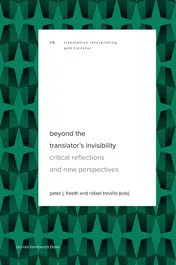
Beyond the Translator’s Invisibility
Recharting Territories
Situatedness and Performativity

Translation Policies in Legal and Institutional Settings

Transfer Thinking in Translation Studies
Recharting Territories
Children’s Literature in Translation

Personality Matters
Affect in Translation and Interpreting
Retranslating the Bible and the Qur’an
CB-relatie 8004161 · Bijgewerkt 6 augustus 2026