
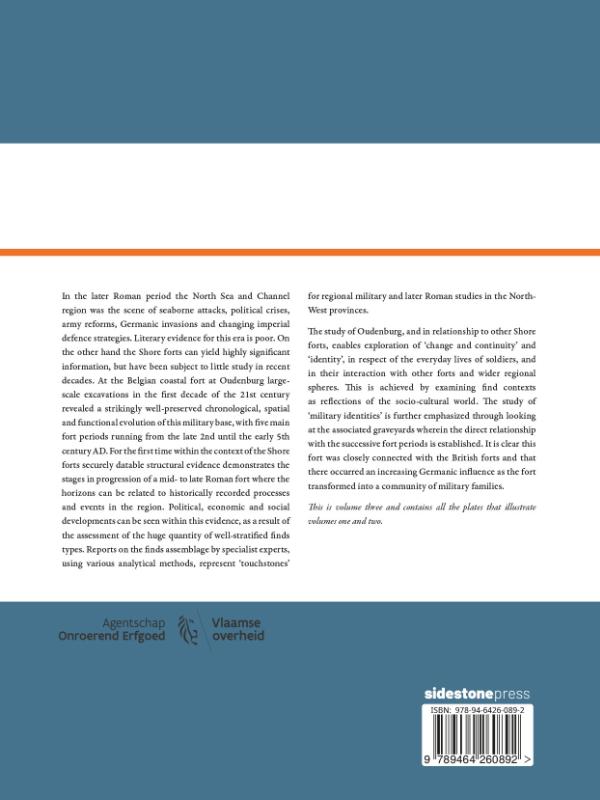
Change and continuity at the Roman coastal fort at Oudenburg from the late 2nd until the early 5th century AD Volume II: The material culture of the south-west corner site
CHAPTER 1. The potteryA. Imported fine waresB. Imported coarse waresC. Local and imported handmade waresD. Local wheel-thrown waresE. The North Menapian pottery group. Reviewing an important 2nd- and 3rd-century local/regional ceramic industryCHAPTER 2. The coinsCHAPTER 3. The metal findsCHAPTER 4. The items in worked animal products (antler, horn, bone and ivory)CHAPTER 5. The jet and jet-like findsCHAPTER 6. The glass findsCHAPTER 7. The figurinesCHAPTER 8. The leather findsCHAPTER 9. The ceramic building materialCHAPTER 10. The stone implementsAPPENDIX. The key context assemblagesBIBLIOGRAPHYIn the later Roman period the North Sea and Channel region was the scene of seaborne attacks, political crises, army reforms, Germanic invasions and changing imperial defence strategies. Literary evidence for this era is poor. On the other hand the Shore forts can yield highly significant information, but have been subject to little study in recent decades. At the Belgian coastal fort at Oudenburg large-scale excavations in the first decade of the 21st century revealed a strikingly well-preserved chronological, spatial and functional evolution of this military base, with five main fort periods running from the late 2nd until the early 5th century AD. For the first time within the context of the Shore forts securely datable structural evidence demonstrates the stages in progression of a mid- to late Roman fort where the horizons can be related to historically recorded processes and events in the region. Political, economic and social developments can be seen within this evidence, as a result of the assessment of the huge quantity of well-stratified finds types. Reports on the finds assemblage by specialist experts, using various analytical methods, represent ‘touchstones’ for regional military and later Roman studies in the North-West provinces.The study of Oudenburg, and in relationship to other Shore forts, enables exploration of ‘change and continuity’ and ‘identity’, in respect of the everyday lives of soldiers, and in their interaction with other forts and wider regional spheres. This is achieved by examining find contexts as reflections of the socio-cultural world. The study of ‘military identities’ is further emphasized through looking at the associated graveyards wherein the direct relationship with the successive fort periods is established. It is clear this fort was closely connected with the British forts and that there occurred an increasing Germanic influence as the fort transformed into a community of military families.This is volume two of three and provides detailed reports on the finds assemblage of the south-west corner site of the Oudenburg fort.
In het kort
ISBN-13
9789464260878
Uitgever
Verschenen
27 mei 2022
Imprint
Bibliografisch
ISBN-139789464260878
SerieRelicta Monografieën — deel 19
Editie1
TaalEngels eng
Pagina’s600
GeïllustreerdJa
Uitgave
UitgeverSidestone Press
ImprintSidestone Press
CB-relatie-id9180064
Verschenen27 mei 2022
StatusOnbekend 00
Vorm & inhoud
ProductvormHardback BB
SamenstellingLos product
Classificatie
NUR (hoofd)Archeologie 682
NUR (alle)682 Archeologie
Medewerkers
Bewerker B05Sofie Vanhoutte
Herkomst
Werk-id (NSTC)501492054
MeldingBevestigd bij publicatie 03
Bijgewerkt6 augustus 2026
Lijkt op dit boek
Change and continuity at the Roman coastal fort at Oudenburg from the late 2nd until the early 5th century AD
Social dynamics in the orthwest frontiers of the late roman empire
Settling with the norm?
Roman Pottery in the Low Countries
Roman villas
Clothes Make the Man
Cremation in the Early Middle Ages
Strategy and Structures along the Roman Frontier
Living and dying on the Roman Frontier and beyond
Silver beyond Empire
NSTC 501492054 · CB-relatie 9180064 · Bijgewerkt 6 augustus 2026