
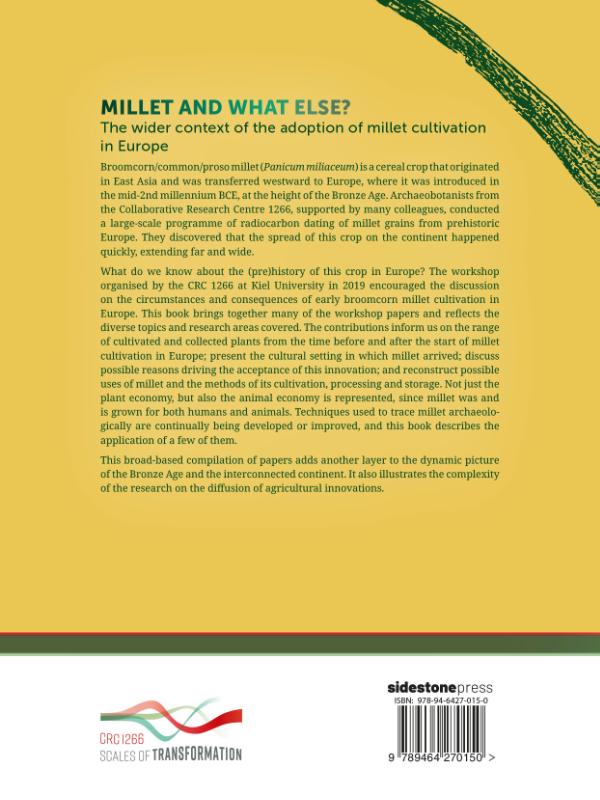
Millet and What Else? The Wider Context of the Adoption of Millet Cultivation in Europe
Millet and what else? The wider context of the adoption of millet cultivation in EuropeWiebke Kirleis, Dragana Filipović, Marta Dal CorsoPART 1: Innovations in the Bronze Age Subsistence Economy: Regional Perspectives from Ukraine to FranceThe (pre)history of common millet (Panicum miliaceum) in Ukraine and its place in the traditional cuisineGalyna PashkevychBronze Age plant spectra in Hungary before and after the introduction of millet cultivationSofia FilatovaBronze Age novelties in animal exploitation in the Carpathian Basin in a European contextLásló BartosiewiczUnearthing millet in Bronze and Iron Age CroatiaKelly Reed, Jacqueline Balen, Ivan Drnić, Sara Essert, Hrvoje Kalafatić, Marija Mihaljević, Emily ZavodnyThe earliest finds of millet and possible associated changes in material culture in SloveniaTjaša Tolar and Primož PavlinOn the ‘ancient’ evidence for Panicum miliaceum and Vicia faba in central Germany (primarily Saxony-Anhalt)Monika HellmundMillets in Bronze Age agriculture and food consumption in northeastern FranceFrançoise Toulemonde, Julian Wiethold, Emmanuelle Bonnaire, Geneviève Daoulas, Marie Derreumaux, Frédérique Durand, Bénédicte Pradat, Oriane Rousselet, Caroline Schaal, Véronique Zech-MatterneOnsite to offsite: A multidisciplinary and multiscale consideration of the 13th to 11th century BCE transformation in northern GermanyIngo Feeser, Stefanie Schaefer-Di Maida, Stefan Dreibrodt, Jutta Kneisel, Dragana FilipovićPART 2: Approaching Millet Cultivation and Consumption through High-end Microscopy, Chemistry and EthnographyPutting millet into a culinary context: Organic residue analysis and the identification of Panicum miliaceum in pottery vesselsEdward A. Standall, Oliver E. Craig, Carl HeronExploiting the feasibility of biomarker analysis in alluvial contexts: The first miliacin evidence from the northern Italian Bronze AgeMarta Dal Corso, Marco Zanon, Carl Heron, Mauro Rottoli, Michele Cupitò, Elisa Dalla Longa, Wiebke KirleisExploring seed impressions within the fabric of pottery: Using a silicone cast method for reliable identificationEiko EndoTraditional millet cultivation in the Iberian Peninsula: Ethnoarchaeological reflections through the lens of social relations and economic concernsAndrés Teira-BriónVersatile usage of millet: brooms and animal fodder from Sorghum technicumWiebke Kirleis and Marta Dal CorsoEarly cultivation of millet in Europe: what else and where next? Concluding the workshop proceedingsDragana Filipović, Marta Dal Corso, Wiebke KirleisBroomcorn/common/proso millet (Panicum miliaceum) is a cereal crop that originated in East Asia and was transferred westward to Europe, where it was introduced in the mid-2nd millennium BCE, at the height of the Bronze Age. Archaeobotanists from the Collaborative Research Centre 1266, supported by many colleagues, conducted a large-scale programme of radiocarbon dating of millet grains from prehistoric Europe. They discovered that the spread of this crop on the continent happened quickly, extending far and wide.What do we know about the (pre)history of this crop in Europe? The workshop organised by the CRC 1266 at Kiel University in 2019 encouraged the discussion on the circumstances and consequences of early broomcorn millet cultivation in Europe. This book brings together many of the workshop papers and reflects the diverse topics and research areas covered. The contributions inform us on the range of cultivated and collected plants from the time before and after the start of millet cultivation in Europe; present the cultural setting in which millet arrived; discuss possible reasons driving the acceptance of this innovation; and reconstruct possible uses of millet and the methods of its cultivation, processing and storage. Not just the plant economy, but also the animal economy is represented, since millet was and is grown for both humans and animals. Techniques used to trace millet archaeologically are continually being developed or improved, and this book describes the application of a few of them.This broad-based compilation of papers adds another layer to the dynamic picture of the Bronze Age and the interconnected continent. It also illustrates the complexity of the research on the diffusion of agricultural innovations.
In het kort
ISBN-13
9789464270150
Uitgever
Verschenen
15 april 2022
Imprint
Bibliografisch
ISBN-139789464270150
SerieScales of Transformation — deel 14
Editie1
TaalEngels eng
Pagina’s320
GeïllustreerdJa
Uitgave
UitgeverSidestone Press
ImprintSidestone Press Academics
CB-relatie-id9180064
Verschenen15 april 2022
StatusOnbekend 00
Vorm & inhoud
ProductvormPaperback BC
SamenstellingLos product
Classificatie
NUR (hoofd)Archeologie 682
NUR (alle)682 Archeologie
Medewerkers
Herkomst
Werk-id (NSTC)501478783
MeldingBevestigd bij publicatie 03
Bijgewerkt6 augustus 2026
Lijkt op dit boek
Millet and What Else?
Beyond heterogeneities
Cooking with plants in ancient Europe and beyond
Quarries and mines in social context
Archaeology in the Žitava valley II
The eve of destruction?
Population dynamics and land-use patterns in the southwestern Baltic region during the Neolithic and the Bronze Age
The Life and Journey of Neolithic Copper Objects
Separation, hybridisation, and networks
From Ros to Prut
NSTC 501478783 · CB-relatie 9180064 · Bijgewerkt 6 augustus 2026