
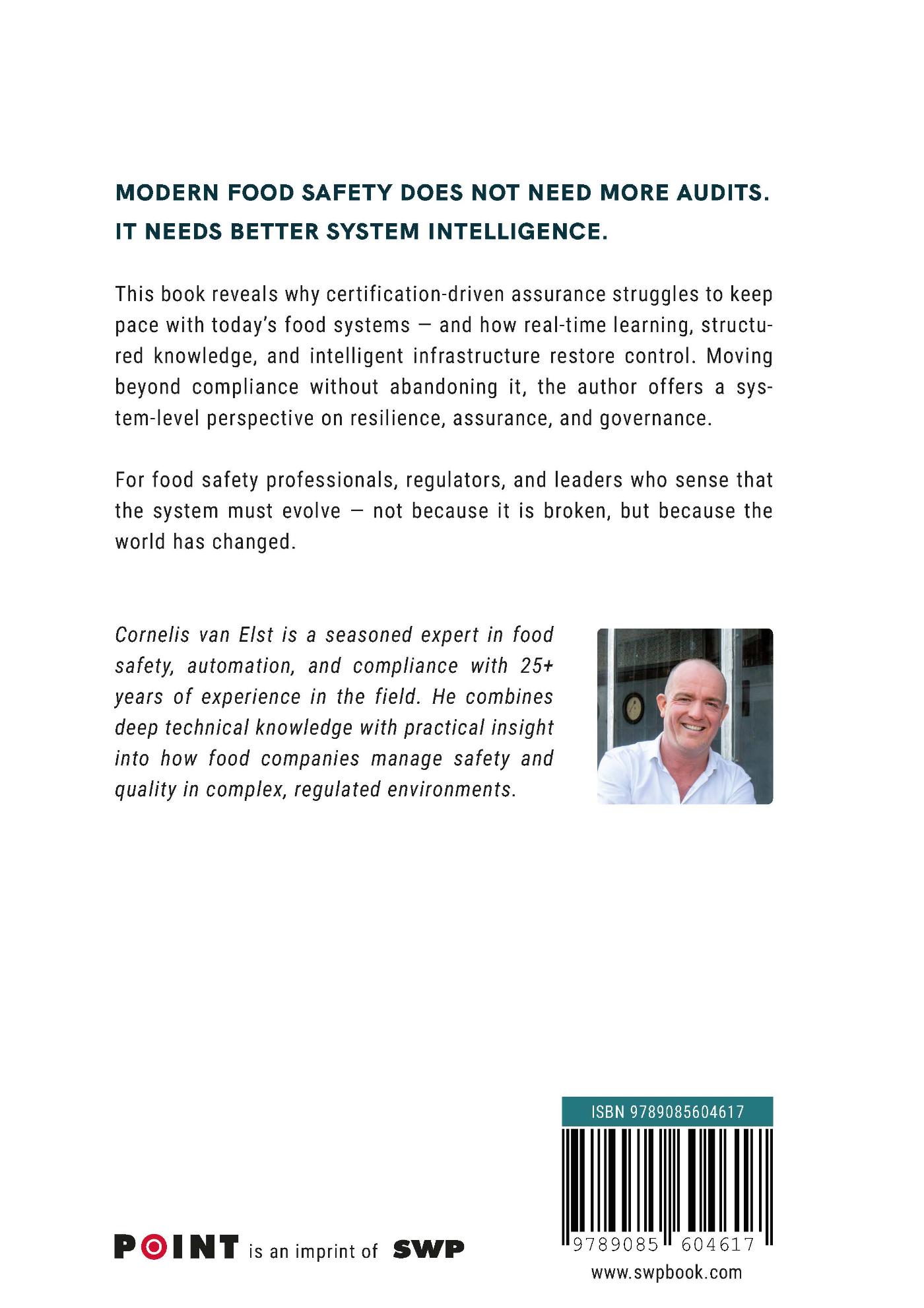
Real-Time Food Safety Assurance 365 Days of Trust — From Periodic Compliance to Continuous Learning
E-book190 pagina’sNederlands
Ook verkrijgbaar als
Modern food safety does not need more audits.
It needs better system intelligence.
This book reveals why certification-driven assurance struggles to keep pace with today's food systems - and how real-time learning, structured knowledge, and intelligent infrastructure restore control. Moving beyond compliance without abandoning it, the author offers a system-level perspective on resilience, assurance, and governance.
For food safety professionals, regulators, and leaders who sense that the system must evolve - not because it is broken, but because the world has changed.
Food safety systems worldwide appear robust. Standards are established, certification schemes are widely adopted, audits are routinely performed, and compliance is carefully documented. On paper, control looks strong.In practice, many of these systems struggle to cope with the realities they face today.
This book starts from a simple observation: food safety has become more complex, faster-moving, and more interconnected than the assurance models designed to govern it. While risk dynamics have accelerated, much of the assurance architecture remains rooted in periodic verification, retrospective proof, and external validation.The result is not failure, but structural strain.
Organizations work harder to maintain compliance without necessarily gaining a deeper understanding. Auditors operate under increasing pressure within narrow mandates.
Consultants fill recurring gaps without transferring durable capability. Regulators face growing oversight challenges with limited real-time visibility.
This book argues that the challenges of food safety stem not from insufficient standards or effort, but from a learning deficit created by system design.
From Compliance to Learning to Assurance
The book introduces a three-phase perspective on food safety maturity:
– Phase 1: Compliance—establishing procedures, maintaining records, and demonstrating conformity through audits
– Phase 2: Learning—building systematic understanding of how systems behave, how risks evolve, and how knowledge flows across domains
– Phase 3: Assurance—achieving sustained confidence through continuous insight, integrated intelligence, and the capacity to detect and respond to emerging conditions
It needs better system intelligence.
This book reveals why certification-driven assurance struggles to keep pace with today's food systems - and how real-time learning, structured knowledge, and intelligent infrastructure restore control. Moving beyond compliance without abandoning it, the author offers a system-level perspective on resilience, assurance, and governance.
For food safety professionals, regulators, and leaders who sense that the system must evolve - not because it is broken, but because the world has changed.
Food safety systems worldwide appear robust. Standards are established, certification schemes are widely adopted, audits are routinely performed, and compliance is carefully documented. On paper, control looks strong.In practice, many of these systems struggle to cope with the realities they face today.
This book starts from a simple observation: food safety has become more complex, faster-moving, and more interconnected than the assurance models designed to govern it. While risk dynamics have accelerated, much of the assurance architecture remains rooted in periodic verification, retrospective proof, and external validation.The result is not failure, but structural strain.
Organizations work harder to maintain compliance without necessarily gaining a deeper understanding. Auditors operate under increasing pressure within narrow mandates.
Consultants fill recurring gaps without transferring durable capability. Regulators face growing oversight challenges with limited real-time visibility.
This book argues that the challenges of food safety stem not from insufficient standards or effort, but from a learning deficit created by system design.
From Compliance to Learning to Assurance
The book introduces a three-phase perspective on food safety maturity:
– Phase 1: Compliance—establishing procedures, maintaining records, and demonstrating conformity through audits
– Phase 2: Learning—building systematic understanding of how systems behave, how risks evolve, and how knowledge flows across domains
– Phase 3: Assurance—achieving sustained confidence through continuous insight, integrated intelligence, and the capacity to detect and respond to emerging conditions
In het kort
ISBN-13
9789461540768
Uitgever
Verschenen
12 mei 2026
Imprint
Bibliografisch
ISBN-139789461540768
Editie1
TaalNederlands dut
Pagina’s190
GeïllustreerdJa
Uitgave
Vorm & inhoud
ProductvormE-book ED
VormdetailE200 Reflowable
E101 EPUB
E101 EPUB
SamenstellingLos product
EPUB-versie3
Beveiliging e-bookDigitaal watermerk 02
Classificatie
NUR (hoofd)Levensmiddelentechnologie 946
NUR (alle)946 Levensmiddelentechnologie
Medewerkers
Auteur A01Cornelis van Elst
Herkomst
Werk-id (NSTC)501660440
MeldingBevestigd bij publicatie 03
Bijgewerkt6 augustus 2026
Lijkt op dit boek
Real-Time Food Safety Assurance - the Indian opportunity

Meer dan veilig voedsel

HACCP: gevaren- en risicoanalyse

Private food law

Productverantwoordelijkheid in de levensmiddelenketen
The future of food (fout)
Modern veiligheidsmanagement
The future of food

Productverantwoordelijkheid in de levensmiddelen

Ingredienten van geloofwaardigheid
NSTC 501660440 · CB-relatie 7800937 · Bijgewerkt 6 augustus 2026