
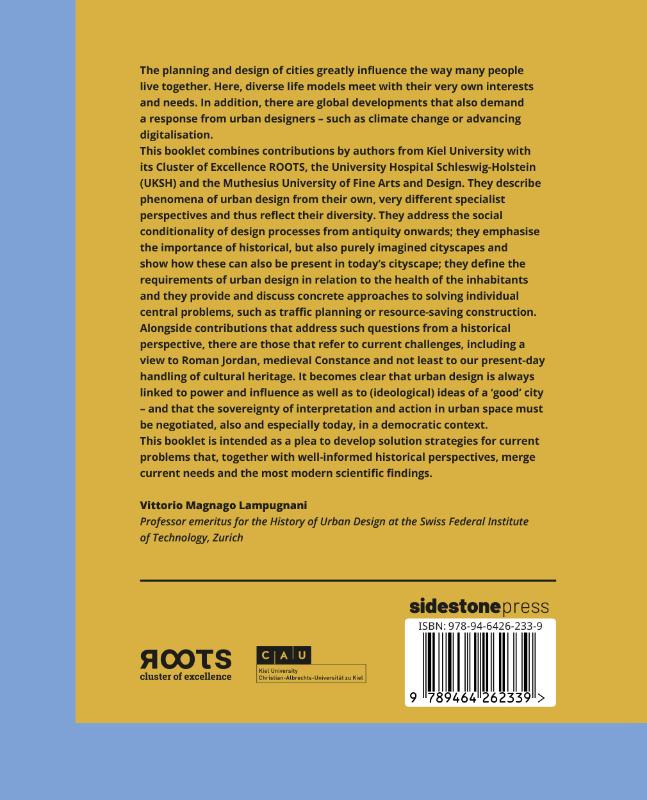
Urban Design Cities in Past, Present and Future
Philipp Kobusch bewerker
PrefaceIntroduction: Urban Design between Past, Present and FutureAnnette HaugArchaeological Heritage in the Historic Urban LandscapeUlrich MüllerUrban Models in Transition: The Roman City in the Levant Region and Its SpacesPatric KreuzSacred Design: ‘Holy Cities’ and ‘City Saints’ in the Middle AgesAndreas BihrerMental Conceptions of Cities in Literary Texts of the Middle AgesMargit DahmCity, Memory and Orientation: Design Features of an Age-friendly CityAnnika HanertUrban Living and the Rise of Lifestyle Diseases: Lessons from Microbiome ResearchThomas BoschCAPTN Future: Clean Autonomous Public TransportDirk NowotkaZero Waste ArchitectureSabine SchlüterProgramme, Authorship, Openness: Thoughts on Contemporary Urban DesignVittorio LampugnaniContributorsFor further readingImprintAs central places of human interaction, cities influence the reality of our lives like no other phenomenon. They are in a highly complex, reciprocal relationship with changing environmental, social, political, economic and religious constellations. Accordingly, the demands placed on cities and the ideas associated with them are often subject to highly dynamic change. Especially against the backdrop of increasingly rapid urbanisation, shaping this change is one of today’s central challenges and it deserves a prominent position in public discourse.The booklet “Urban Design” aims to show the complexity of this discourse. It invites reflection on the possibilities of designing cities and their impact on the present and the future. To this end, it brings together contributions from very different disciplines, each of which provides their own perspectives on the phenomenon of the city. A basic idea here is that contemporary cities cannot be designed without a deeper understanding of their historical dimension. On a practical level, this entails the (selective) visualisation of the archaeological cultural heritage, with its implications for identity politics. But its is also concerned with the dependence of historical city images on contemporary discourses, for example, religious ideas and their political utilisation or literary imaginations of the urban. Moreover, the booklet also wants to inquire about the direct effects of material urban design on the residents. For instance, design characteristics influence orientation and movement in urban space and thus determine the movement options of handicapped and elderly people. The urban environment also has a direct impact on human health. The extent to which current discourses on environmental problems and climate change are changing the requirements for urban design is exemplified by contributions on the topics of transport and climate-neutral construction. It is to be expected that innovative ideas in these areas, in particular, will change the appearance of the cities of the future in the long term.
In het kort
ISBN-13
9789464262339
Uitgever
Verschenen
21 oktober 2023
Imprint
Bibliografisch
ISBN-139789464262339
SerieRoots Booklet Series — deel 03
Editie1
TaalEngels eng
Pagina’s84
GeïllustreerdJa
Uitgave
UitgeverSidestone Press
ImprintSidestone Press
CB-relatie-id9180064
Verschenen21 oktober 2023
StatusOnbekend 00
Vorm & inhoud
ProductvormPaperback BC
SamenstellingLos product
Classificatie
NUR (hoofd)Archeologie 682
NUR (alle)682 Archeologie
Medewerkers
Bewerker B05Annette Haug
Bewerker B05Philipp Kobusch
Herkomst
Werk-id (NSTC)501563407
MeldingBevestigd bij publicatie 03
Bijgewerkt6 augustus 2026
Lijkt op dit boek
Roots of Routes
Connectivity Matters!
Stories of Waste and Value
Discourses on Modernity
Living (World) Heritage Cities
Urban challenges, resilient solutions
Urban climate design
Archaeological Approaches to Inequality, Political Organisation, and Social Complexity
Shaping Cultural Landscapes
HISTORY URBANISM RESILIENCE
NSTC 501563407 · CB-relatie 9180064 · Bijgewerkt 6 augustus 2026