
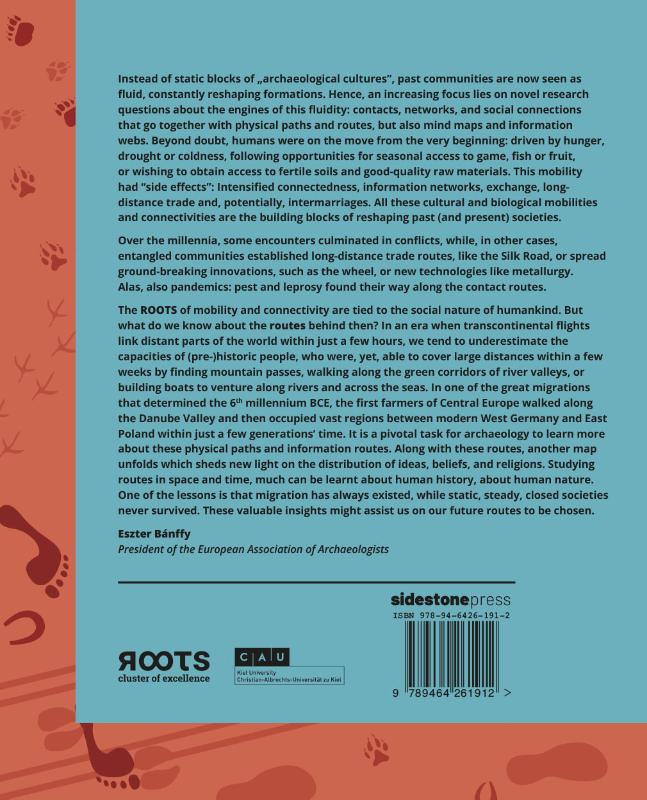
Roots of Routes Mobility and Networks between the Past and the Future
Preface: Perspectives on Past Routes, Networks and Society in Challenging TimesJohannes MüllerChapter 1: The ROOTS of Routes – Framing Connections in (Pre-)HistoryIntroduction: A Deep History of Routes Connecting People, Places, and IdeasHenny Piezonka, Lutz Käppel, Andrea RicciGlobalisation? What Globalisation?Tim KerigChapter 2: How to Choose a Route?Routes in the Landscape – Ecological and Social Conditions for the Exchange of Goods, Ideas and People in the PastWalter DörflerEntangled Mobilities – The Interconnection of Human Routes and Animal MovementHenny Piezonka and Karolina VarkuleviciuteClimate RefugeesMara WeineltChapter 3: How Far Back Do Our Routes Go?Sunken Pathways in the North Sea – Tracking Late Palaeolithic Reindeer Hunters off the Coast of HeligolandBerit Valentin Eriksen and Wolfgang RabbelRooting the Silk RoadJohanna Hilpert and Jutta KneiselOn the Road Again: Travelling through Jutland – The Ox Trail, a Millennia-old RoadJutta Kneisel, Bente Majchczack, Franziska Engelbogen, Anna K. Loy, Oliver NakoinzWalking on Ancient Paths – Are We Still Using Celtic Trails?Franziska EngelbogenConnection Breakdown – Three Vikings AbroadJens Schneeweiß and Henny PiezonkaChapter 4: Routes of Things and TechnologiesCattle and Wagons – The First “Wild West” in Europe? The Wheel Innovation in the Baltic-Pontic Region 3500-2500 BCEJohannes MüllerTrackways across the BogJan-Piet BrozioRoad to Riches – Amber Routes in Bronze Age EuropeBenjamin Serbe and Khurram SaleemAnalysing AmberKhurram Saleem and Benjamin SerbeThe Power of Water – Water Connectivities in MesopotamiaAndrea RicciHow Did Buddha Come to Sweden?Jens SchneeweißChapter 5: Routes of Rituals and KnowledgeAt the End of the Road – What Graves Tell Us about Networks and Contacts in PrehistoryFynn Wilkes and Henry SkornaMermaids, Faces, Houses and Birds – Symbols of ConnectivityJutta KneiselTheoria – The Pilgrimage to the Sanctuary as a Journey to Knowledge or What the Modern Concept of “Theory” Has to Do with a Religious Practice in Ancient GreeceLutz KäppelPathways between the Worlds – The Sacred Ecology of River RoutesHenny PiezonkaChapter 6: Conclusions and OutlookAlong the Way: A Look Back AheadLutz Käppel, Henny Piezonka, Andrea RicciMap of Project LocationsContributorsFor further readingImprintPeople and spaces have always been connected by routes: paths, trails, roads – on land, on water and sometimes even through the air, over hill and dale as well as over wooden planks, pavement and asphalt. Humans and animals followed them. The routes directed the circulation of raw materials and goods. They determined the paths on which humans fled from misery and danger, and they constituted the physical and imagined veins of networks between communities. All these cultural and biological connectivities are the building blocks of reshaping past (and present) societies.In this booklet – the second in the booklet series of the Cluster of Excellence ROOTS at Kiel University – we uncover the roots of these routes: From the earliest stages of the Stone Age to the present day, there have been well-defined routes, which enabled the exchange of things, practices and knowledge between people. Many of these ancient routes are not only still visible today, but even continue to operate: from the Silk Roads spanning the continents to the local routes of the Ox Trail in Schleswig-Holstein, from the waterways of Mesopotamia and the river worlds of the forest zone to the spiritual routes of philosophical contemplation. Moreover, isolation and disruptions of formerly established routes, for example in the Viking diaspora, have also proven to be directional for cultural developments. In a kaleidoscope of perspectives, the roles of landscape and climate are examined. Special attention is given to those routes along which objects, rituals, and therefore also cultural practices were transported. Religious rituals, knowledge, even philosophical insights are shown to have their roots in movement along routes.These and the many other topics in this booklet illustrate to what extent the development of human societies is determined by the routes through which they are connected – or not connected. Modern narratives of a limitless, openly accessible world, grounded in an urban-industrialised experience (or agenda), can get cracks if we look deep enough into the past. It is the paths, the very concrete connections in a material as well as a spiritual sense that influence human lives, their existence and their development. Communication and dialogue along the routes and networks must be maintained, as they were and are the guarantors for a good coexistence of humans in this world.
In het kort
ISBN-13
9789464261912
Uitgever
Verschenen
15 juni 2023
Imprint
Bibliografisch
ISBN-139789464261912
SerieRoots Booklet Series — deel 02
Editie1
TaalEngels eng
Pagina’s122
GeïllustreerdJa
Uitgave
UitgeverSidestone Press
ImprintSidestone Press
CB-relatie-id9180064
Verschenen15 juni 2023
StatusOnbekend 00
Vorm & inhoud
ProductvormPaperback BC
SamenstellingLos product
Classificatie
NUR (hoofd)Archeologie 682
NUR (alle)682 Archeologie
Medewerkers
Herkomst
Werk-id (NSTC)501548695
MeldingBevestigd bij publicatie 03
Bijgewerkt6 augustus 2026
Lijkt op dit boek
Connectivity Matters!
Urban Design
Stories of Waste and Value
Bridging Social and Geographical Space through Networks
Shaping Cultural Landscapes
Archaeological Approaches to Inequality, Political Organisation, and Social Complexity
Epistemology, Economics, and Ethics
Discourses on Modernity
Appropriating Height
Resources in Premodern Societies
NSTC 501548695 · CB-relatie 9180064 · Bijgewerkt 6 augustus 2026