
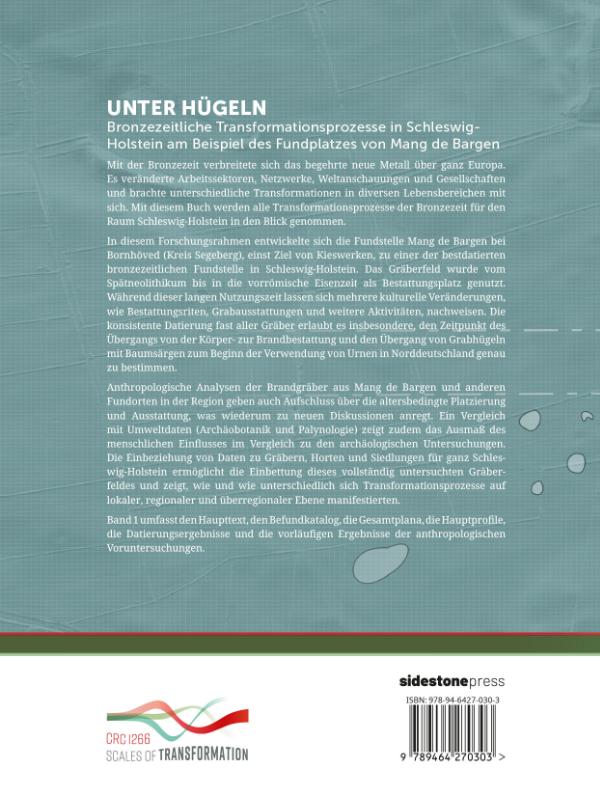
Unter Hügeln (BAND 1) Bronzezeitliche Transformationsprozesse in Schleswig-Holstein am Beispiel des Fundplatzes von Mang de Bargen (Bornhöved, Kr. Segeberg)
Ook verkrijgbaar als
Preface of the series editorsVorwort der Autorin1. Einleitung1.1. Projektvorstellung1.2. Kooperationen1.3. Aufbau der Arbeit2. Transformationsbegriff2.1. Definition2.2. Transformationstypen2.3. Transformationsmodelle3. Ziele und Fragestellungen4. Methoden und theoretische Grundlagen5. Arbeitsgebiet: Geographie und Geologie5.1. Schleswig-Holstein5.2. Fundplatz von Mang de Bargen, Bornhöved (Kr. Segeberg)6. Quellen und Quellenkritik7. Chronologie der ‚Nordischen Bronzezeit‘7.1. Forschungsgeschichte7.2. Bronzezeitliche Chronologie im Arbeitsgebiet7.3. Eisenzeit8. Mikroebene: Transformationsprozesse am Fundplatz von Mang de Bargen8.1. Forschungsgeschichte & Stand der Forschung8.2. Neue Feldforschungen im Rahmen der Dissertation8.3. Befunde8.4. Fundmaterial8.5. Chorologie des Fundmaterials8.6. Chronologie8.7. Leichenbrandanalysen8.8. Botanische Großrestanalysen8.9. Pollenanalysen8.10. Kulturelle Einbettung des Fundplatzes von Mang de Bargen8.11. Transformationsprozesse am Fundplatz von Mang de Bargen9. Mesoebene: Transformationsprozesse in Schleswig-Holstein9.1. Zur Datenaufnahme9.2. Zur Datenauswertung9.3. Befunde9.4. Materielle Kultur9.5. Formenkunde: Gliederung älterbronzezeitlicher Keramik aus Schleswig-Holstein9.6. Transformationsprozesse in Schleswig-Holstein10. Schlussbetrachtung11. Fazit und Ausblick12. LiteraturverzeichnisAnhangI. KatalogII. GesamtplanaIII. HauptprofileIV. Tabelle zu den 14C-DatierungsergebnissenV. Tabelle zu den vorläufigen anthropologischen Analysen zu den DatierungsprobenDuring the Bronze Age the new, eponymous, highly-desired metal spread widely across Europe. It changed labour sectors, networks, worldviews and societies, and brought with it different transformations in diverse areas of life and death. With this book, all changes from the Bronze Age for the area of Schleswig-Holstein were put under the spotlight.In this framework of research, the Mang de Bargen site near Bornhöved (district of Segeberg), once the target of gravel works, developed into one of the best-dated Bronze Age sites in Schleswig-Holstein. The cemetery was used from the Late Neolithic to the Pre-Roman Iron Age as a burial site. During this long period of use, several cultural changes, including burial rites, grave furnishings, and further activities, can be traced. The rigorous dating of almost all of the graves allows, in particular, the precise identification of the moment of transition from inhumation to cremation, as well as the shift from burial mounds with log coffins to the beginning of the use of urns in northern Germany.Anthropological analyses of the cremations from Mang de Bargen and other sites in the area also reveal the age-related placement and furnishings, which might in turn stimulate new discussions. A comparison with environmental data (archaeobotany and palynology) also shows the scope of human impact in comparison to the archaeological investigations. The inclusion of data on graves, hoards, and settlements for the whole of Schleswig-Holstein enables this fully-investigated cemetery to be contextually embedded, and shows how — and how differently — transformation processes manifested themselves at local, regional, and supra-regional levels.Volume 1 comprises the main text, the feature catalogue, the site plans, the main site profiles, the results of the radiometric dating and the interim results of the preliminary anthropological investigations.
In het kort
ISBN-13
9789464280494
Uitgever
Verschenen
25 april 2023
Bibliografisch
ISBN-139789464280494
SerieScales of Transformation — deel 16
Editie1
TaalEngels eng
Pagina’s376
GeïllustreerdJa
Uitgave
Vorm & inhoud
ProductvormHardback BB
SamenstellingLos product
Classificatie
NUR (hoofd)Archeologie 682
NUR (alle)682 Archeologie
Medewerkers
Auteur A01Stefanie Schaefer-Di Maida
Herkomst
Werk-id (NSTC)501514102
MeldingBevestigd bij publicatie 03
Bijgewerkt6 augustus 2026
Lijkt op dit boek
Unter Hügeln (BAND 2)
Beyond heterogeneities
The Life and Journey of Neolithic Copper Objects
Elite Mobility and Funerary Practices in Early Iron Age Europe
From Ros to Prut
Coming together, keeping apart: Volume 1
Breaking and making the ancestors
Population dynamics and land-use patterns in the southwestern Baltic region during the Neolithic and the Bronze Age
The eve of destruction?
A completely normal practice
NSTC 501514102 · CB-relatie 9180064 · Bijgewerkt 6 augustus 2026